Showing posts sorted by date for query Joseph Smith polygamy. Sort by relevance Show all posts

Saturday, December 12, 2015

Google "Joseph Smith's wives" or "Fanny Alger"

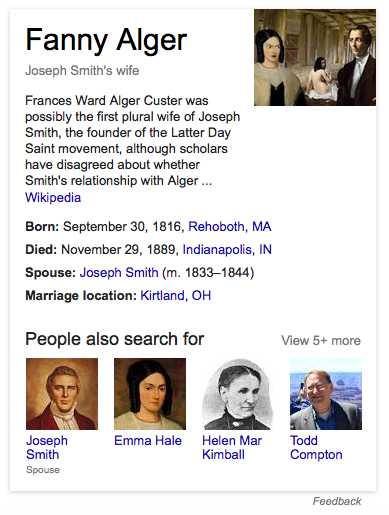
If you search for "Joseph Smith's wives" in Google, please take the time to scroll to the end of the names and pictures at the top. It looks something like this:


It would appear that Fanny's picture comes from my blog post about her. I got it from this AMAZING VIDEO. Amazing as it is, it's not entirely accurate. No angel with a drawn sword was needed to convince Joseph Smith to practice polygamy until the early 1840s, several years after he had hooked up with Fanny and a few others. That's right, it doesn't make sense and it's not the only thing about the sword story that doesn't make sense.

The doubters seem well pleased. Emma looks pissed.


I'm just happy to have helped make a slight difference in the world.

Friday, October 9, 2015

Gary Stevenson criticized

I think it's only fair that we take a look a the words of our newly called apostles. We all deserve to know just what exactly they can testify of. What witness can they give? Elder Stevenson's recent General Conference talk with my comments.


Dear brothers and sisters, it has been many decades since a general conference has been convened that President Boyd K. Packer and Elders L. Tom Perry and Richard G. Scott were not seated immediately behind the podium and speaking at one of these sessions. It's also been many decades that people have been hoping and praying that Boyd just fucking die already. That man was a monster. Our memories of them are poignant, and I add my tribute to honor them, each so uniquely different yet so harmonized in their witness and testimony of Jesus Christ and His Atonement. It's not too hard to harmonize when both their witnesses and the Atonement are complete mysteries. None of them ever claimed to have seen Jesus and none of them ever gave a satisfactory explanation of the Atonement.

Furthermore, I, like you, find strength in and sustain President Thomas S. Monson as prophet, seer, and revelator, and I marvel at his faithful and dutiful apostolic service spanning over 50 remarkable years. Like me? Never in my life have I been impressed with Monson's record as a prophet, seer or revelator (but it was rumored in the mission that he had a photographic memory and that impressed me).


And so it was on Tuesday morning of this week, just after 9:00 a.m. as the Bishopric was beginning a meeting with the Asia Area Presidency, who are here for conference, that I was called to meet with President Monson, along with his counselors. "And so it was"? Where did that come from? You weren't telling a story or any kind of narrative that calls for a "and so it was". Moments later, as I walked into the boardroom adjacent to his office, I must have looked nervous sitting across the table, as he kindly spoke to calm my nerves. It's nice to know Tommy remembered his manners considering he can remember so little these days. He commented, noting my age, that I seemed quite young and even looked younger than my age. This sentence is both horribly redundant and hardly information worthy of your audience. I hope you get better at telling stories real fast.

Then, within a few moments, President Monson described that acting on the will of the Lord, he was extending a call to the Quorum of the Twelve to me. How do we know he was acting on the will of the Lord? Was Jesus to busy to call his own "special witness"? He asked me if I would accept this call, to which, following what I am sure was a very undignified audible gasp, in complete shock, I responded affirmatively. "Guh! Wha? Really? You want me to back the Porche out of the garage? Wow! OK, sure!" Dude, Gary, where was your wife in all this? And then, before I could even verbalize a tsunami of indescribable emotion, most of which were feelings of inadequacy, President Monson kindly reached out to me, describing how he was called many years ago as an Apostle by President David O. McKay, at which time he too felt inadequate. But don't worry, you'll learn to fake the shit out of this whole apostle thing! And the pain of being a fraud fades fast. He calmly instructed me, “Bishop Stevenson, the Lord will qualify those whom He calls.” You'll soon find justifications for why your "special witness" consists of nothing more then the same happy feelings that make a Mia Maid cry at girl's camp. It's your position, bro! It's the cumulative faith of everyone who believes you have a particularly special relationship with Jesus not unlike the one the original apostles had 2000 years ago. These soothing words of a prophet have been a source of peace, a calm in a storm of painful self-examination and tender feelings in the ensuing agonizing hours which have passed day and night since then. Monson the soothsayer. I don't think Mormons are supposed to like soothsayers. Flattering people is a no no.

I rehearsed what I have just described to you to my sweet companion, Lesa, later that day, seated in a quiet corner on Temple Square, with a serene view of the temple and the historic Tabernacle lying before us. Oh, here she is! Isn't it beautiful how Tommy and his crew took no consideration of her in this whole process and left it entirely up to you? I'm sure she was thrilled to have this new popped on her like an unexpected wedding engagement! :S As we tried to comprehend and process the events of the day, we found our anchor to be our faith in Jesus Christ and our knowledge of the great plan of happiness. In other words you sat around confessing that you had no idea what the fuck was going on, but it's all good because Jesus is rad and his plan is the best? Whatever works for you, man. This leads to an expression of my deepest love for Lesa. She is the sunshine in and of my life and a remarkable daughter of God. Sounds... condescending... Hers is a life punctuated by selfless service and unconditional love of all. So she's the perfect Mormon woman who has given up everything to bear children and watch her husband move up the ladder of success. How 1950s of you two. I will strive to remain worthy of the blessing of our eternal union. It's time to close your Ashley Madison account.

I express my deepest love to our four sons and their families, three of whom are here with their beautiful wives, the mothers of our six grandchildren; the fourth, a missionary, has special permission to stay up past missionary curfew and is viewing these proceedings live with his mission president and the mission president’s wife from their mission home in Taiwan. Oh, the mandatory pater familias creds. No thanks. I love each of them and love how they love the Savior and the gospel. Chances are one of those grandkids is going to up and leave the Church one day. I hope you still love him or her then.

I express my love to each member of my family: to my dear mother and to my father, who passed away last year, who instilled in me a testimony which seemed to dwell in me from my earliest memories. That's called childhood indoctrination. Had you been born in another part of the world, just imagine what you might have known from the earliest age. I further extend this gratitude to my brother, sisters, and their faithful spouses, as well as Lesa’s family, many of whom are actually here today. They didn't fucking nominate you for an award, man. This isn't the Oscars. I cast this net of gratitude to numerous extended family, friends, missionaries, leaders, and teachers along the way. Now thank Jesus for looking favorably upon your whiteness and delightsomeness.

I have been blessed with a close association with the members of the First Presidency, the Twelve, the Seventy, and the general auxiliary presidencies. I express my love and esteem to each of you sisters and brothers and will strive to be worthy of our continued association. This sounds like a business promotion speech. The Presiding Bishopric enjoys an almost heavenly unity. Sounds sexual. I will miss my association each day with Bishop Gérald Caussé, Bishop Dean M. Davies, and the staff. Especially the hot young staffers (you know who you are!).


I stand before you as evidence of the words of the Lord recorded in the first section of the Doctrine and Covenants: “That the fulness of [the] gospel might be proclaimed by the weak and the simple unto the ends of the [earth], and before kings and rulers.” Enough with the false humility bullshit. You and Ronny are probably going to get into fights over who's the most humble about your new calling. These words are preceded by the Lord’s declaration which demonstrates the love of a Father for His children: “Wherefore, I the Lord, knowing the calamity which should come upon the inhabitants of the earth, called upon my servant Joseph Smith, Jun., and spake unto him from heaven, and gave him commandments.” Right, because fathers who love their kids a ton call up one of them - and only one (who happens to live in an extremely remote part of the world) - to give emergency preparedness instructions. Contacting each child individually is too time consuming for a father. By the way, is this the same father who called a council in heaven? He obviously regretted calling it.

Our loving Heavenly Father and His Son, Jehovah, with a knowledge of the end from the beginning, opened the heavens and a new dispensation to offset the calamities that They knew would come. Oh, Mormon polytheism, how the rest of the Christian world deplores it! The Apostle Paul described the forthcoming calamities as “perilous times.” Fear mongering. For me, this suggests that Heavenly Father’s generous compensation for living in perilous times is that we also live in the fulness of times. Yes! It's so wonderful living in a day and age when polygamy and abstinence from coffee have been restored! It totally makes up for all the killing going on around us constantly. :S

As I agonized over my inadequacies this week, I received a distinct impression which both chastened and comforted me: to focus not on what I can’t do but rather on what I can do. Whoa! This almost sounds like a spiritual experience! It's not quite a visitation from Jesus, but we'll be damned if we don't take it! I can testify of the plain and precious truths of the gospel. Which are what? I'm only asking because nothing in Mormonism seems very clear or precious to me these days.

These are the words which I have shared hundreds of times with both those who belong to the Church and many who are not members: “God is our [loving] Heavenly Father. I seriously doubt that. We are His children. I so doubt that. … He weeps with us when we suffer and rejoices when we do what is right. I can't see how that's even possible. He wants to communicate with us, and we can communicate with Him through sincere prayer. I've tried it often. It never worked. …

“Heavenly Father has provided us, His children, with a way to … return to live in His presence. He's got an awesome TV, a huge Blue Ray collection, tons of tasty treats, cozy furniture and is a generous cuddler. … Central to our [Heavenly] Father’s plan is Jesus Christ’s Atonement.” Ah, yes. The Atonement! That nonsensical act in which torture and bloodshed satiated the demands of some powerful law that God himself couldn't disregard or build around. 


Heavenly Father sent His Son to the earth to atone for the sins of all mankind. Because he was powerless to forgive. He absolutely had to have payment for every last sin. Of these plain and precious truths I bear my testimony, and I do so in the name of Jesus Christ, amen. Oh, shit! These were the "plain and precious truths"? I'm not better off in understanding this stuff than I was before.

Wednesday, August 12, 2015

LDS FAQ - "Masonry and the Temple"

I found a brief Church-sanctioned (I believe) explanation of the LDS temple's relationship to Freemasonry. I'm curious what it says. Text found here.


Students of both Mormonism and Freemasonry have pondered possible relationships between Masonic rites and the LDS temple ceremony. Although some argue that Joseph Smith borrowed elements of Freemasonry in developing the temple ceremony, the Endowment is more congruous with LDS scriptures (especially the book of Abraham and the Book of Moses) and ancient ritual than with Freemasonry. Both the book of Abraham and the Book of Moses are texts Joseph made up out of thin air, so I personally don't see why anyone would feel better knowing that they've influenced the creation of the LDS temple ceremonies. Pointing out that the temple has more more in common with those writings than with Freemasonry still doesn't justify the presence of Masonic oaths and handshakes in the temple. Latter-day Saints view the ordinances as a revealed restoration of ancient temple ceremony and only incidentally related to Freemasonry. There's no good reason to think the LDS temple ceremonies are ancient and I'm looking forward to seeing how you continue to downplay the influence of Freemasonry. The two are not antithetical, however, nor do they threaten each other, and neither institution discourages research regarding the ancient origins of their two ceremonies. The origins of Freemasonry are not ancient at all, they are medieval, late medieval. Many sacred ceremonies existed in the ancient world. Modified over centuries, these rituals existed in some form among ancient Egyptians, Coptic Christians, Israelites, and Masons, and in the Catholic and Protestant liturgies. Is this written for 6th graders? I can't believe you dared list the Masons in this group. And Egyptians? WTF? Which Egyptians are you talking about? Common elements include the wearing of special clothing, ritualistic speech, the dramatization of archetypal themes, instruction, and the use of symbolic gestures. Levi Strauss would be so proud to read this, but aren't these elements too broad to be taken seriously in this particular discussion of Freemasonry in the LDS temple? One theme common to many—found in the Egyptian Book of the Dead, the Egyptian pyramid texts, and Coptic prayer circles, for example—is man's journey through life and his quest, following death, to successfully pass the sentinels guarding the entrance to eternal bliss with the gods. Right, Thor and all his buddies in Valhalla. Though these ceremonies vary greatly, significant common points raise the possibility of a common remote source. Human psychology most likely. Mormon wishful thinking knows no ends.


The Egyptian pyramid texts, for example, feature six main themes: (1) emphasis on a primordial written document behind the rites; (2) purification (including anointing, lustration, and clothing); (3) the Creation (resurrection and awakening texts); (4) the garden (including tree and ritual meal motifs); (5) travel (protection, a ferryman, and Osirian texts); and (6) ascension (including victory, coronation, admission to heavenly company, and Horus texts). Oh my god, that's so... DIFFERENT from the Mormon temple! Wow. Like such ancient ceremonies, the LDS temple Endowment presents aspects of these themes in figurative terms. Only if you're working in the most sympathetic of generalizations. It, too, presents, not a picture of immediate reality, but a model setting forth the pattern of human life on earth and the divine plan of which it is part. We're going to need some actual details here. It sounds like you're seeing what you want to see. It's called confirmation bias.
 

Masonic ceremonies are also allegorical, depicting life's states—youth, manhood, and old age—each with its associated burdens and challenges, followed by death and hoped-for immortality. The difference between your argument for the temple paralleling an Egyptian Book of Breathings and the Freemason ceremonies is that Joseph actually knew Masons and became one himself. On the other hand, he had no understanding of Egyptian despite having purchased a scroll containing a book of breathings. He feigned a translation that is laughable to today's Egyptologists. There is no universal agreement concerning when Freemasonry began. Maybe not, but no one can seriously claim it pre-dates the late Middle Ages. Some historians trace the order's origin to Solomon, Enoch, or even Adam. Only Mormon historians. Others argue that while some Masonic symbolism may be ancient, as an institution it began in the Middle Ages or later. Only everyone who isn't Mormon thinks this.
 

Though in this dispensation the LDS Endowment dates from Kirtland and Nauvoo, Latter-day Saints believe that temple ordinances are as old as man and that the essentials of the gospel of Jesus Christ, including its necessary ritual and teachings, were first revealed to Adam. Mormons have no basis for believing this other than the fact that Joseph Smith, a notorious conman, taught it to his followers and it has been believed and repeated for generations. These saving principles and ordinances were subsequently revealed to Seth; Noah; Melchizedek; Abraham, and each prophet to whom the priesthood was given, including Peter. There is no historical evidence to convince us most of these men ever existed (Peter is the exception) and much less evidence that they ever practiced the ceremonies of the current LDS temples. Latter-day Saints believe that the ordinances performed in LDS temples today replicate rituals that were part of God's teachings from the beginning. But they have no reason to believe anything similar. Hopefully the author of this article will cite some convincing texts.


The Prophet Joseph Smith suggested that the Endowment and Freemasonry in part emanated from the same ancient spring. Joe Smith? He's not a very trustworthy source. Do you know he tried to trick investors into funding an illegal bank? The man was as phony as a $3 bill. Thus, some Nauvoo Masons thought of the Endowment as a restoration of a ritual only imperfectly preserved in Freemasonry and viewed Joseph Smith as a master of the underlying principles and allegorical symbolism (Heber C. Kimball to Parley P. Pratt, June 17, 1842, Church Archives). I'm sure those few unnamed Freemasons were totally right... The philosophy and major tenets of Freemasonry are not fundamentally incompatible with the teaching, theology, and doctrines of the Latter-day Saints. Obviously not, but that does not mean they derive from ancient biblical patriarchs or that one group did not co-opt them from the other. Both emphasize morality, sacrifice, consecration, and service, and both condemn selfishness, sin, and greed. So what? You're talking about two groups who's morality is founded in Christian European thought. You're also ignoring the fact that essentially every ethnography you'll read will describe cultures who's beliefs include similar concepts and virtues. That says more about human psychology than it does about the LDS temple being ancient. Furthermore, the aim of Masonic ritual is to instruct-to make truth available so that man can follow it.
 

Resemblances between the two rituals are limited to a small proportion of actions and words; indeed, some find that the LDS Endowment has more similarities with the Pyramid texts and the Coptic documents than with Freemasonry. At this point, dear reader you should compare and contrast the text shared between the temple endowment and the Mason ceremonies. They are in many cases identical! Even if we are to accept the author's claim that they only make up a "limited" portion of the temple, that DOES NOT justify their presence in temple liturgy. I would love to see where the endowment plagiarizes Coptic liturgy in the way. Even where the two rituals share symbolism, the fabric of meanings is different. Because Joseph took the symbols and recast them for his own purposes. In addition to creation and life themes, one similarity is that both call for the participants to make covenants. You keep dancing around the details. I find this approach willfully dishonest. Yet, the Endowment alone ties covenants to eternal blessings and to Jesus Christ. How did you reach this conclusion? Your argument is "OK, we have similarities, but ours is legit, theirs isn't, trust me!"? I'm not impressed. The Masonic ceremony does not emphasize priesthood or the need to be commissioned by God to represent him. So whoever emphasizes that the most wins? What kind of moronic game are you playing? The active participation of God in the world and in men's lives is a distinctly LDS temple motif. As is God's active participation with women, but only through men. It's called divine sexism. While Masons believe in an undefined, impersonal God, everything in the LDS Endowment emanates from, or is directed to, God who is a personage and man's eternal Father. That doesn't mean Joseph Smith didn't steal the Masonic rituals and infuse them into his own thought. The Endowment looks to the eternities and to eternal lives, but Freemasonry is earthbound, pervaded by human legend and hope for something better. Because Joseph had to outdo everyone, including himself.


Freemasonry is a fraternal society, and in its ritual all promises, oaths, and agreements are made between members. In the temple Endowment all covenants are between the individual and God. You finally seem to be admitting they use the same oaths (which they do), even if directed to different entities. In Freemasonry, testing, grading, penalizing, or sentencing accords with the rules of the fraternity or membership votes. In the Endowment, God alone is the judge. You lost me. Do you mean that the Freemasons actually take quality control seriously while Mormons just let anything go in the temple? That's dishonest. In the Mormon temple you have someone checking on you every step of the way making sure you do everything just right. The difference being that Freemasons have to learn everything by heart and then get tested, whereas Mormons get to copy what's shown to them on the spot. Within Freemasonry, rank and promotions are of great importance, while in the LDS temple rites there are no distinctions: all participants stand equal before God. Not really. Men and women have separate seating and gendered clothing, including a veil to cover the faces of women. Husbands are placed over wives in the temple. Men get to become king and priests and women queens and priestesses. Historically kings ruled over their queens and we have no idea what a priestess even does according to Mormon doctrine. This is not equality. The clash between good and evil, including Satan's role, is essential to, and vividly depicted in, the Endowment, but is largely absent from Masonic rites. So Joseph added a maniacal Satan to the stage, so what? This is a red herring. You need to look at the details you so diligently avoid! That's where you'll find the real devil. Temple ceremonies emphasize salvation for the dead through vicarious ordinance work, such as baptism for the dead; nothing in Masonic ritual allows for proxies acting on behalf of the dead. Because it's a ridiculous notion. Why would a fraternity need to induct the deceased? Women participate in all aspects of LDS temple rites; though Freemasonry has women's auxiliaries, Masonic ritual excludes them. Freemasonry is a men's club, just like the LDS endowment was back when it was introduced. Both have changed (Mormonism first, thanks to polygamy) to be more inclusive of women. The Endowment's inclusion of females underscores perhaps the most fundamental difference between the two rites: LDS temple rites unite husbands and wives, and their children, in eternal families (see Eternal Lives; Marriage). Now you've moved away from the endowment, where the Masonic plagiarism is found, to the sealing room. You've just moved the goal posts, moron. Latter-day Saint sealings would be completely out of place in the context of Masonic ceremonies. Incredible. I almost want to give you points for trying, except I feel like you're purposefully being sloppy in your analysis of Freemasonry and the LDS temple. I don't know if you're being dishonest or if you simply don't know what you're doing.
 

Freemasonry's 5 points of contact as used in the LDS temple endowment until 1990.

Thus, Latter-day Saints see their temple ordinances as fundamentally different from Masonic and other rituals and think of similarities as remnants from an ancient original. This conclusion is only reached by ignoring the verbatim theft of oaths, the co-opting of symbols, the exact copying of handshakes, and many other elements, while simultaneously cherry picking cultures to compare your beliefs to and then staying back in the vaguest of generalities in order to avoid seeing your comparison implode.

KENNETH W. GODFREY should be ashamed of himself.

Temple prep - Endowed from on High "Lesson 7"

I'm reading the Church Education System's manual for temple preparation and adding my two cents. Text found here.

Objective

“For behold, I have accepted this house, and my name shall be here; and I will manifest myself to my people in mercy in this house” (D&C 110:7). When was the last time someone claimed to have seen Jesus in the temple? When was the last time a sane and honest person saw JC in the temple?
To follow up on the class members’ first visits to the temple and help them prepare to enjoy the temple throughout their lives. This should be the best lesson of the series. Finally the students have some actual experience to base their knowledge off of instead of the cryptic BS they've been pretending to understand. Now we can finally talk for real about the temple.

Preparation

  1. Be prepared to make this lesson a time of sharing. Most class members will want to discuss their first visit to the temple. They'll also feel a fair amount of pressure to only say positive things and will likely be more than a little nervous to speak their minds freely.
  2. Assign a class member to be prepared to read Doctrine and Covenants 110:1–10 and share his or her feelings about it. I know theses thoughts are meant to be shared later, but I'll go ahead and write them here. First off, holy shit! Jesus sounds both very scary and also pretty fucking cool! Secondly, I'm kind of bummed I didn't see Jesus in the temple and more bummed I didn't see anyone who seemed to be seeing him or even conversing with angels. Thirdly, I have no idea where Jesus would even be hanging out in the temple for us to see. Maybe in the Celestial Room smoking a pipe by the fireplace. I don't know. Finally, I think temples totally have made Mormons famous all over the world, unfortunately it's also made them infamous thanks to LDS practices of baptizing people for the dead that the living don't want baptized.
  3. Assign a class member to summarize the information about Elijah presented in Preparing to Enter the Holy Temple, pages 23–24. In a nutshell, Elijah the prophet keeps coming back from the dead to wave his priesthood fingers about and turn all of our hearts to our fathers. This usually happens in mid-June in the United States. Thanks, Elijah! See you next year!
  4. Prepare to answer questions that may have arisen during the first visit to the temple, but do not discuss questions or information that should be reserved for discussion in the temple itself. Can we talk about what the True Order of Prayer? That shit was WEIRD! But also, if that's the true order then why the hell are we taught to kneel on the ground, fold our arms, bow our heads and close our eyes? Should we be teaching little kids to raise their hands in the air and lower them saying "Oh God, here the words of my mouth!"? Where such questions exist, encourage individuals to plan additional visits to the temple. Where in the temple would students be expected to talk about the taboo subjects of temple worship? The temple president's office? I really don't know the answer.

Lesson Presentation

Ask class members if they have any questions. I have a question! When you went through the temple did they still have an evil Protestant minister helping Satan deceive the children of man? Is it not ironic in light of the fact that the LDS Church is very much a product of the Reformation? What? Those questions are no longer relevant because the Protestant minister has been edited out? OK, well can you explain why women are covenanting to their husbands rather than to the Lord like the men do? Can you explain why we need a new name to give at the veil? Where do these new names come from anyway? Take the time required to answer questions to the best of your ability and as guided by the Lord’s Spirit. The Lord's spirit will be the only guidance you can hope for because the Church isn't giving you anything to work from. Remember that some aspects of temple work must not be discussed outside the temple. I think the only things we promised to never reveal are our new names and the bizarre succession of Masonic signs and tokens, right? Why can't we talk about them again? Don't say it's because they're sacred. We talk about lots of sacred things like baptism, testimony moments, motherhood, the Atonement, the Plan... Don't we think everything in Mormon doctrine is sacred?

Maintaining a Love for Temple Service

  • How did you feel when you were in the temple? Nervous. I knew less about what I was supposed to do than I anticipated. I felt like I was being cornered sometimes.
Explain that temple service will bring continuing blessings into the lives of those who go often to the temple. "Continued blessings"? What the hell are you talking about? Tell the class members that while their experience in the temple is still fresh in their minds, they may want to write their feelings about it in their journals. So they can laugh at their own ignorance later on in life. Remind them that although they may record their feelings, they should not write about some details of temple work, which are not to be discussed outside the temple. What are they not allowed to write exactly? Is it not strange that you're trying to censor their journals?
  • What can you do to maintain a love for temple service throughout your life? If you stay in the Church long enough you'll automatically become an obsessive old temple goer. Temple "work" is one of the only entertainment options for old Mormons. It's either the temple or the megaplex. Either way you're watching a movie. You might find yourself loving it earlier if you become a parent and you start convincing yourself that your child needs to have an "eternal marriage".
Write the class members’ ideas on the chalkboard. You may also want to present the following ideas:
1. Ponder the temple experience each day. And couple that pondering with some reading material.
Explain that some people have more opportunities to visit the temple than others. But once we have been to the temple and felt the Spirit there, we should take the opportunity each day to ponder the temple ceremonies and reflect upon the covenants we have made. If you rarely or barely feel the Spirit in the temple, you should also ponder that. You're probably just a sinner, but there's also a chance that the temple isn't what it claims to be. Doing this will encourage us each day to think and act in more righteous ways. But not more ethically.
We will not be able to remember everything about the temple, but we should try to remember as much as possible after each visit. Or you can just hop online and look up whatever it is you've forgotten. We should also study the scriptures and words of the prophets about the temple. They don't say much that's substantial. Some of these have been presented in this course. And you remember how hollow those words were, don't you?
You may want to have a class member summarize the following statement, found on page 10 in Preparing to Enter the Holy Temple:
“The temple ceremony will not be fully understood at first experience. It will be only partly understood. Largely because we will not teach you what you need to understand it, nor will we tell you who understands it fully, and don't even dream of finding someone to sit down with who will even try to explain it fully. Saying you understand the temple completely is a form of Mormon heresy. Return again and again and again. And keeping finding "symbols" for yourself so you feel smarter. Return to learn. Things that have troubled you or things that have been puzzling or things that have been mysterious will become known to you. Are you admitting that the temple can trouble people? Can you give an example of something troubling? Why would the temple, a place where we are discouraged from talking and where there are no lectures or classes, be a better place to answer questions than say a Sunday School lesson, where we get to bounce ideas off each other with the supposed help of the Spirit? …
“When you have the opportunity to attend an endowment session in the temple or to witness a sealing, ponder the deeper meaning of what you see demonstrated before you. What deeper meaning? There doesn't even have to be one, you just have to make us believe there is one? And in the days following your visit keep these things on your mind; quietly and prayerfully review them and you will find that your knowledge will increase. The best review involves gently touching your silky garment symbols over and over.
“One of the great values of the temple experience is that it presents the broad, sweeping panorama of God’s purposes relating to this earth. Once we have been through the temple (and we can return and refresh our memories) the events of life fit into the scheme of things. We can see in perspective where we are, and we can quickly see when we are off course.” You don't have to build multi-million dollar temples to see this. Just do a Google search for the "plan of salvation" and print of one of the images that pop up. It's very cheap and easy.
2. Remember that the center of all temple worship is the Savior, Jesus Christ. Is it? I always felt that it was our self-importance and impatience to become gods.
The scriptures teach that an important reason for building temples is so “that the Son of Man might have a place to manifest himself to his people” (D&C 109:5). And yet he's just not popping in very often, is he? The symbols and rituals of the temple help to focus our attention on the Savior. To be completely honest, imagining Eve naked behind a bush distracted me a little...
Explain that the Savior did manifest Himself in the Kirtland Temple. That was the first and last time he did anyone that favor. He appeared to Joseph Smith and Oliver Cowdery to accept the temple as His house. Uh, I have my doubts. This visit is recorded in Doctrine and Covenants 110:1–10. Ask the assigned class member to read and comment on this passage. I put my comments on these verses at the beginning of the post.
  • What blessings did the Savior promise to those who build and attend temples? Health in the navel, marrow in the bones... no, wait! That's something else. OK, he said he show up in mercy (wouldn't it be weird for a guy who's already affectionately paid for your sins show up and punish you for being a sinner?), and that he'd pour out "blessings". Thanks for the "blessings", Lord!

In the Temple, Families Are Sealed Together for Eternity

Ask the class members to read Malachi 4:5–6.
Ask the assigned class member to summarize the information about Elijah found in Preparing to Enter the Holy Temple, pages 23–24. I summarized this above.
Explain that Elijah has returned and restored the priesthood keys that allow families to be sealed together in temples for eternity. Don't ask me why Peter, the dude to whom Jesus supposedly gave the power to seal, did give Joseph those "keys" years earlier when he allegedly dropped out of heaven with his pals James and John and bestowed the Melchizedek priesthood upon him.
Have the class members review Doctrine and Covenants 110:13–16. This is the scripture where Elias shows up with his Greek name tag and then shows up again with his Hebrew name tag and is mistaken for a different person. Great story. :S Then ask a class member to read the following statement, found on page 28 in Preparing to Enter the Holy Temple:
“From that very day, April 3, 1836, the hearts of the children began to turn to their fathers. Before that, all children hated their fathers and never thought of them, especially not to help them. Thereafter ordinances were not tentative, but permanent. Baptism was tentative before 1836? Ordination to the Priesthood was tentative!! Are you serious? The sealing power was with us. Rest easy, kids, this highly suspicious story Joseph Smith told means we've got the most powerful magic of any religion. You're in the right place! No authorization transcends it in value. So never ever under any circumstance take seriously what other religions say they have to offer. That power gives substance and eternal permanence to all ordinances performed with proper authority for both the living and the dead.” You'll feel it, brothers and sisters. It will feel low key. Almost anticlimactic. Kind of like the awesomeness of it all was in what was said, not so much in what was done and what happened afterward. What I'm saying is don't expect to see the Lord or anything amazing like that. Keep your expectations to a minimum.
The Savior described the sealing power when He spoke to His Apostle Peter, as recorded in Matthew 16:19. This verse is so strange. If Peter had pronounced chocolate ice cream to be eternally in all celestial freezers, would God have respected that? Does the New Testament give us any idea if Peter actually used this special power at all? Have the class members read this verse.
Explain that these same keys are held today by the prophet and President of the Church. You should see the incredible Lego sets that Tommy Monson has bound on earth and in heaven! “That sacred sealing power is with the Church now. How it works is if you're lucky enough to be a man, you can get sealed to numerous women, and if you're a woman who divorces or is widowed and want to get sealed to a new husband, you can't. Nothing is regarded with more sacred contemplation by those who know the significance of this authority. Which doesn't exactly explain why Heber Kimball said he took no more thought about taking another wife than he did about getting another cow. Nothing is more closely held. Well, except for penises. Those get held pretty darn tightly. There are relatively few men who hold this sealing power upon the earth at any given time—in each temple are brethren who have been given the sealing power. They are among our most special and unique sorcerers. No one can get it except from the prophet, seer, and revelator and President of The Church of Jesus Christ of Latter-day Saints or from those he has delegated to give it to others” Seriously, these sealing sorcerers are pretty close to the top of the pig pile. (Preparing to Enter the Holy Temple, 24, 26).
Explain that the sealing ordinances include the sealing of a husband and wife to each other and the sealing of parents to children. That's right, kids, sealings are no longer just about polygamy! When parents are sealed in the temple, the children born to them are born in the covenant of their parents’ sealing and do not need to be sealed to their parents. But the Lord does require paperwork from everyone else. Sorry.
  • How do you think being sealed together in the temple might affect the daily thoughts and actions of a family? It definitely gives a false sense of security and contributes to some pretty smug attitudes toward those families who haven't been sealed.
  • What blessings do you think would come to a family because of their temple sealing? Earthy blessings? None. I thought the deal was they'd get to be together after they die.
President Gordon B. Hinckley said: “Was there ever a man who truly loved a woman, or a woman who truly loved a man, who did not pray that their relationship might continue beyond the grave? Yes. Has a child ever been buried by parents who did not long for the assurance that their loved one would again be theirs in a world to come? Unfortunately, yes. Can anyone believing in eternal life doubt that the God of heaven would grant his sons and daughters that most precious attribute of life, the love that finds its most meaningful expression in family relationships? Yes, easily. No, reason demands that the family relationship shall continue after death. You'll have to explain your reasoning I'm afraid. The human heart longs for it, and the God of heaven has revealed a way whereby it may be secured. What if this is just an emotionally immature desire that only mere mortals suffer from? Why would a God who knows everything, can be everywhere and is the definition of love not be entirely satisfied with his relationship to his creation (children included) at all times regardless of where their physical presence my be? The sacred ordinances of the house of the Lord provide for it” You're selling a solution to a problem that doesn't exist. (“Why These Temples?” Temples of The Church of Jesus Christ of Latter-day Saints [1988], 4).

Temples Give Us Opportunities to Serve Those Who Have Died

Have the class members read Obadiah 1:21. That's one trippy script, brother! I'm sure you'll make it mean whatever you want it to mean.
The Prophet Joseph Smith explained how members of the Church can become saviors on Mount Zion:
“But how are [the Saints] to become saviors on Mount Zion? By giving Joseph - ahem! the Church... a lot of money and fee labor? By building their temples, erecting their baptismal fonts, and going forth and receiving all the ordinances, baptisms, confirmations, washings, anointings, ordinations and sealing powers upon their heads, in behalf of all their progenitors who are dead, and redeem them that they may come forth in the first resurrection and be exalted to thrones of glory with them; and herein is the chain that binds the hearts of the fathers to the children, and the children to the fathers, which fulfills the mission of Elijah” (History of the Church, 6:184). Sounds like a lot of work for something that isn't even necessary.
“This vicarious work performed in our temples must be carried forth in the same spirit of selfless devotion and sacrifice that characterized the life of the Master” (President Thomas S. Monson). I'm 100% sure that Jesus never asked for this sort of "service" once in the Gospels. Jesus wanted our efforts directed 100% at worshiping the Father through service to the living. 
Explain that as part of His plan of salvation, our Heavenly Father has prepared a way for those who died without receiving the saving ordinances of the gospel to receive these ordinances. It's not a very effective way, so in the end you find yourself questioning God's judgement. The people in the spirit world have the opportunity to hear the gospel. I'm amazed they'd even have to wait for an opportunity to hear the gospel. It seems like once you pass through the veil your memory of the War in Heaven would return and you'd know exactly where you are and what went wrong. They can accept it there, but they cannot receive the ordinances of the gospel for themselves. Because why? The Lord has commanded us to perform these ordinances for them in holy temples. Kind of. Joseph got people going on vicarious baptisms way before baptismal fonts were part of temples. I guess that baptisms for the dead in rivers and lakes really pissed the Lord off. We should make special efforts to do family history work so we can receive ordinances in behalf of our own ancestors. Should we though? I think our energies could be directed toward the living. Imagine if instead of spending 2.5 hours in the temple, Mormons went out and helped in nursing homes or tutored in schools and libraries or cleaned up trash or helped in community vegetable gardens. 

 
Ordinances for the dead performed in temples include baptisms, confirmations, ordinations to the priesthood, endowments, and sealings of husband to wife and parents to children.
We should return to the temple as often as our circumstances permit so that we can serve those who have died by performing ordinances for them. The temples are recycling names these days because they have more people going through than they have new names of the dead. Many names are irretrievable. Let's focus instead on the real work that needs to be done and leave this "work" for the dead for the Millennium. We will bless the lives of those we serve and bless our own lives as well. You don't see the irony in what you said, do you? You're talking about "blessing the lives" of the dead... Information about how to do family history work and perform ordinances for our ancestors is provided in A Member’s Guide to Temple and Family History Work. Now get busy!
President Thomas S. Monson said:
“An appreciation for the temple endowment and the sealing ordinances will bring the members of our families closer together and there will be quickened within each family member a desire to make available these same blessings to our loved ones who have gone beyond. Most people my age can't be bothered. They've got way too much to do with work and children. I think this urgency is more likely to hit once you're old and retired. …
“This vicarious work performed in our temples must be carried forth in the same spirit of selfless devotion and sacrifice that characterized the life of the Master. Just don't think too hard about how the Master focused on the living and never told people to save their dead ancestors by being baptized for them. When we remember him, it becomes easier for us to do our individual parts in this vital work. Only if you remember him in a certain way, a way that makes you believe vicarious ordinances for the dead were somehow his idea. Each time we gaze upon one of these holy houses, may we be reminded of the eternal opportunities which are found inside, not only for ourselves, but for our dead” (Pathways to Perfection [1973], 206–7). Every time you look at a temple you should be thinking about how one day you and all your family could live together in a cloudy community of Gods on a crystal planet. How's that for motivation?

Conclusion

Emphasize that temple attendance allows us to serve others and to continue to gain greater spiritual knowledge. Probably the greatest service you're doing in the temple is keeping elderly people company. The second greatest service is that you're providing jobs for temple cleaners, cafeteria workers and laundry cleaners. Share the following statement:
“No work is more of a protection to this Church than temple work and the genealogical research which supports it. No work is more spiritually refining. What? How does genealogical work protect the Church? By giving it a research organ that actually does credible work unlike the moronic apologists over at BYU and FAIR? No work we do gives us more power. Relax. Accept that you're a mortal like the rest of us. No work requires a higher standard of righteousness. … Keep fanning our self-righteous ego! It feels so good!
“If we will accept the revelation concerning temple ordinance work, if we will enter into our covenants without reservation or apology, the Lord will protect us. Protect us from what? What the hell are you talking about? What are you so afraid of? We will receive inspiration sufficient for the challenges of life. That sounds like minimal inspiration, which is definitely what I got during my years of activity. …
“So come to the temple—come and claim your blessings. They're the unspecific blessings we'll work the whole rest of our lives trying to identify. It is a sacred work” (Preparing to Enter the Holy Temple, 37). It is what you want it to be, I guess. I actually dared to want something otherworldly and beautiful. What I got was human and mundane. I doubted my doubts, but I could only delude myself for so long before letting it go.
End the lesson by sharing testimonies. I'd like to bear my testimony that the LDS temple is not a restoration of ancient ceremony ordain and demanded by Heavenly Father. From what I see, the temple is the product of Joseph Smith trying to impress his followers with something bigger and more complicated than he had previously shown them. It's the result of a religious hack trying to outdo himself. I say this in the name of honest contemplation and historical evidence. Amen. Encourage the class members to return often to the temple so that they can be taught by the Spirit of the Lord. Isn't this what's supposed to be happening in church on Sundays? Why would regular church services be unable to reach this goal of being taught be the Spirit?
You may want to mention that the class members may be able to obtain from Church distribution centers and view at home the video presentation Mountain of the Lord. This 73-minute presentation tells the story of the building of the Salt Lake Temple. It's just more propaganda. You can skip it, like this whole lesson.

Sunday, July 19, 2015

Temple prep - "Sacred Covenants"

The following text is taken from the pamphlet "Preparing to Enter the Holy Temple" (2002) and annotated by me.


The Lord in the revelation now known as section 132 of the Doctrine and Covenants announces:
For behold, I reveal unto you a new and an everlasting covenant; and if ye abide not that covenant, then are ye damned; for no one can reject this covenant and be permitted to enter into my glory.
For all who will have a blessing at my hands shall abide the law which was appointed for that blessing, and the conditions thereof, as were instituted from before the foundation of the world. (D&C 132:4–5.) This is the section Joseph "received" justifying polygamy. The new and everlasting covenant is unequivocally plural marriage. This is also the section that threatens Emma with death if she doesn't let Joseph marry the women he's already married and marry even more that he hasn't yet married.

President Joseph Fielding Smith defines the new and everlasting covenant in these words:
What is the new and everlasting covenant? I just told everyone, sorry. I regret to say that there are some members of the Church who are misled and misinformed in regard to what the new and everlasting covenant really is. Totally! Many believe it's eternal marriage. The new and everlasting covenant is the sum total of all gospel covenants and obligations. Huh? You know you didn't really say what it is, right? For those of you who missed it above, the new and everlasting covenant is heaven sanctioned polygyny. (Joseph Fielding Smith, Doctrines of Salvation, 3 vols. [Salt Lake City: Bookcraft, 1954–56], 1:156; hereafter cited as Doctrines of Salvation.)
This covenant includes all ordinances of the gospel—the highest of which are performed in the temple. To quote President Smith again:
Now there is a clear-cut definition in detail of the new and everlasting covenant. Let's hear the clear-cut version now... It is everything—the fulness of the gospel. That's not very clear. You've just muddled everything into one. It's almost as if you haven't read Section 132. So marriage properly performed, baptism, ordination to the priesthood, everything else—every contract, every obligation, every performance that pertains to the gospel of Jesus Christ, which is sealed by the Holy Spirit of promise according to his law here given, is a part of the new and everlasting covenant. Once again, that is not the definition the Lord gave in Section 132. I think you're probably trying really hard to downplay the importance of polygamy to early Mormonism. (Doctrines of Salvation, 1:158.)
In the verse quoted previously (Doctrine and Covenants 132:4) the Lord spoke with unmistakable plainness: “… for no one can reject this covenant and be permitted to enter into my glory.” Right. The purpose of this revelation was to force Emma into accepting her husband's sleeping around. Emma however had the good sense to burn the revelation when Hyrum brought it to her (because Joseph didn't have the balls to bring it to her himself).

Those who go to the temple have the privilege of taking upon themselves specific covenants and obligations relative to their exaltation and that of others. Please tell us all exactly what these covenants are. It would be really awkward to drag someone to the temple dress them all up and sit them down for the movie and leave them completely ignorant of the promises they're there to make. Elder James E. Talmage wrote:
The ordinances of the endowment embody certain obligations on the part of the individual, such as covenant and promise to observe the law of strict virtue and chastity, to be charitable, benevolent, tolerant and pure; to devote both talent and material means to the spread of truth and the uplifting of the race; to maintain devotion to the cause of truth; and to seek in every way to contribute to the great preparation that the earth may be made ready to receive her King,—the Lord Jesus Christ. Thank you very much for the list, I just have a question for you: how are these not covered in the baptismal covenants? I think they're already covered, bro. With the taking of each covenant and the assuming of each obligation a promised blessing is pronounced, contingent upon the faithful observance of the conditions. What blessings? Tell us. Actually maybe I'll just take a moment to list them for everyone. The gods promise they "will provide a Savior for you, whereby you may come back into our presence, and with us partake of Eternal Life and exaltation". Part of this partaking of "Eternal Life and exaltation" includes "the day... when you will be... Kings and Queens, Priests and Priestesses" in heaven. It sounds impressive, doesn't it? (The House of the Lord, page 100.)
We covenant with the Lord to devote our time, talents, and means to His kingdom. Meaning what? All of our time, talents and wealth, or just 10%? Do I need to make the LDS Church the sole benefactor in my will? Can you be a little more clear?

We are a covenant people. We covenant to give of our resources in time and money and talent—all we are and all we possess—to the interest of the kingdom of God upon the earth. So I should rewrite my will. In simple terms, we covenant to do good. "Good" according to the Church means "help the Church". "Good" according to Jesus means helping the sick, hungry and downtrodden. We are a covenant people, and the temple is the center of our covenants. The covenant center, if you will. Those meeting houses where we're required to renew our baptismal covenants every week? Not so central. It is the source of the covenant. You might have been thinking Jesus was the source, but he's not. The temples that we make (and only ours, mind you) are a magnificent fountain spewing forth covenants upon the world.

Come to the temple. Don't tell me what to do! You ought to come to the temple. If you want to see the hidden side of Mormonism, then you really ought to. Here, acting as proxy for someone who has gone beyond the veil, you will have reviewed before you the covenants that you have made. This is actually the only way for you to review because the Church won't give you the text to study unless you're one of the actors in the drama. You will have reinforced in your mind the great spiritual blessings that are associated with the house of the Lord. Those blessing (eternal life with God) are what we're promised at baptism though, so feel free to stop at baptism (if you believe in that sort of thing).

Be faithful to the covenants and ordinances of the gospel. Give the Church EVERYTHING YOU'VE GOT and DON'T TELL ANYONE your secret name or passwords and shit! Qualify for those sacred ordinances step by step as you move through life. Don't we have to qualify before we go to the temple? Isn't that what all the interviews were about? Honor the covenants connected with them. Or be prepared to excuse yourself from the endowment when they ask if anyone wants to leave. Don't be nervous - no one ever dares leave. Do this and you will be happy. Unless you're still deeply unsatisfied with things.


Your lives will then be in order—all things lined up in proper sequence, in proper ranks, in proper rows. We have to rank something and put stuff in rows? What? Is this a military analogy? Your family will be linked in an order that can never be broken. On second thought it can still be broken, like in the case of temple divorce, deceased family potentially rejecting the temple ordinances done on earth, living family members abandoning ship, future family members choosing not to do the Mormon thing, or someone like Joseph Smith being sealed to your wife and thereby eternally inheriting all your kids.

In the covenants and ordinances center the blessings that you may claim in the holy temple. No, the blessings mentioned in the temple, with the exception of "protection" thanks to garment wearing, are blessings you can only receive after death. Surely the Lord is pleased when we are worthy of the title: A keeper of the covenants. You know what? I'm not at all sure he is.

Monday, July 13, 2015

Temple prep - "Taught from on High"

The following text is taken from the pamphlet "Preparing to Enter the Holy Temple" (2002) and annotated by me.


Before going to the temple for the first time, or even after many times, it may help you to realize that the teaching of the temples is done in symbolic fashion. I hope you like puzzles! The Lord, the Master Teacher, gave much of His instruction in this way. Because he didn't want to be killed as a blasphemer or an insurrectionist. At least not right away.

The temple is a great school. If you think a good school is one that shows you the same movie over and over and over again. It is a house of learning. This is more or less what my dad told me as we were pulling up to the temple. He claimed that BYU was only called the "Lord's university" but the temple was in fact where the Lord taught us. Talk about setting high expectations! In the temples the atmosphere is maintained so that it is ideal for instruction on matters that are deeply spiritual. It's quiet (essentially no talking to each other at all) but with lots of moving around from room to room or in and out of your chair and mumbling brief sentences you're told you must repeat. The late Dr. John A. Widtsoe of the Quorum of the Twelve was a distinguished university president and a world-renowned scholar. Your appeal to authority is showing! He had great reverence for temple work and said on one occasion:
The temple ordinances encompass the whole plan of salvation, as taught from time to time by the leaders of the Church, and elucidate matters difficult of understanding. Like what? Like why God Satan would hear God's plan for people to be tempted by evil and then voluntarily rebel and become the evil tempter? Or like how god blood pays for sin? Or why God would need to exile all of his favorite children and them blame them for being bad? Or how exactly sealings work for legally divorced couples or for people who will reject the temple work that will be done for them or for couples who have children who have killed themselves and no longer qualify for the Celestial Kingdom? Or do they ever explain what's so godly about polygamy? Those would be some difficult matters I'd love to hear addressed. There is no warping or twisting in fitting the temple teachings into the great scheme of salvation. I don't know, man, I'm still pretty baffled on why Freemasonry is so essential to the Plan... The philosophical completeness of the endowment is one of the great arguments for the veracity of the temple ordinances. I've indicated a few holes for you to fill in above. Moreover, this completeness of survey and expounding of the Gospel plan, makes temple worship one of the most effective methods of refreshing the memory concerning the whole structure of the gospel. A more effective method would be to show one of those little Plan of Salvation maps. They're very simple, can be understood in minutes rather than hours, and don't require memorizing any Masonic bullshit. The only problem is they don't answer the questions I've asked here either.
Another fact has always appealed to me as a strong internal evidence for the truth of temple work. Well if you like it!... The endowment and the temple work as revealed by the Lord to the Prophet Joseph Smith … fall clearly into four distinct parts: The preparatory ordinances; the giving of instruction by lectures and representations; covenants; and, finally, tests of knowledge. Why would any of this have anything to do with "the truth of temple work"? How are you defining truth? And what are your criteria for discovering and recognizing it? I doubt that the Prophet Joseph, unlearned and untrained in logic, could of himself have made the thing so logically complete. He didn't make it all up. He was trained by the Freemasons, dude! After reaching the highest order he just ripped out chunks of their ceremonies and spliced them into a Creation drama rather than a Solomon's temple drama. No over-extension of the imagination was necessary. (John A. Widtsoe, “Temple Worship,” The Utah Genealogical and Historical Magazine 12 [April 1921]: 58.)
To quote again from Elder Widtsoe’s article:
We live in a world of symbols. We know nothing, except by symbols. We make a few marks on a sheet of paper, and we say that they form a word, which stands for love, or hate, or charity, or God or eternity. The marks may not be very beautiful to the eye. No one finds fault with the symbols on the pages of a book because they are not as mighty in their own beauty as the things which they represent. We do not quarrel with the symbol G-o-d because it is not very beautiful, yet represents the majesty of God. We are glad to have symbols, if only the meaning of the symbols is brought home to us. So saying the temple is symbolic or that in the temple we learn through symbols means nothing, because according to your logic the same could be said of everything we learn regardless of where we learn it. You've just made the temple ordinary and mundane, not special and exalting. I speak to you tonight; you have not quarreled very much with my manner of delivery, or my choice of words; in following the meaning of the thoughts I have tried to bring home to you, you have forgotten words and manner. Who's to say no one in the audience is paying any attention to your words and manner? I but someone listening was trained enough in rhetoric to question your delivery. I bet someone who heard you found a jump or two in logic. Even if you miraculously managed to sail your audience smoothly to your final conclusions, I can't see how your lesson on semiotics ties in with the temple. Maybe you should discuss the temple symbols and then compare them to written and spoken symbols. I would be very curious to see what you come up with. …
We live in a world of symbols. No man or woman can come out of the temple endowed as he should be, unless he has seen, beyond the symbol, the mighty realities for which the symbols stand. No man or woman should be expected to come out of the endowment knowing what the symbols stand for without those symbols being given a proper explanation. No one expects a child to be given a book and read it without first being taught how to read. On another note, is the temple necessary for understanding the "realities" of which you speak? Let's take the Masonic symbols on the garments for example. The square, the compass, the dash over the navel and the dash over the knee refer respectively to living a righteous life, being directed toward God (or circumscribed within his realm), spiritual nourishment and finally reverence to Christ. Not only do all of these symbols need further explanation (which cannot be derived from the symbols themselves), each concept can in fact be taught perfectly well without the symbols. There is no essential knowledge to be gained by learning these symbols. None. (“Temple Worship,” page 62.)
Focus on the compass and learn to deviate not.

If you will go to the temple and remember that the teaching is symbolic you will never go in the proper spirit without coming away with your vision extended, feeling a little more exalted, with your knowledge increased as to things that are spiritual. Because you get to sit around and find things to turn into symbols. No one will discourage you, nor will they ask you what you learned because no one cares. There was nothing more to learn anyway. Once you learn to have faith in Jesus and are reborn in him, you've pretty much acquired all the symbolism you need. What's significant after baptism for a Christian, is living like Jesus, which probably means being patient and loving and doing everything you can to help those in need. The teaching plan is superb. Oh man, you need to take a course or two in pedagogy. How is it "superb" if people couldn't even understand him? It is inspired. By gerbils on a wheel. The Lord Himself, the Master Teacher, in His own teaching to His disciples taught constantly in parables, a verbal way to represent symbolically things that might otherwise be difficult to understand. Sure, little stories can be easy to remember, but the message is often lost. As I recall he sometimes taught in parables to keep people in ignorance. He talked of the common experiences drawn from the lives of His disciples, and He told of hens and chickens, birds, flowers, foxes, trees, burglars, highwaymen, sunsets, the rich and the poor, the physician, patching clothes, pulling weeds, sweeping the house, feeding pigs, threshing grain, storing into barns, building houses, hiring help, and dozens of other things. He talked of the mustard seed, of the pearl. But he never used Masonic symbols. He wanted to teach His hearers, so He talked of simple things in a symbolic sense. Except when he didn't want everyone to understand him. None of these things is mysterious or obscure, and all of them are symbolic. It's so strange that everyone doesn't understand Jesus' parables the same way if they were so clear and straight forward. Are you absolutely sure Jesus avoided being a little obscure?

The temple itself becomes a symbol. If you have seen one of the temples at night, fully lighted, you know what an impressive sight that can be. It is very clearly a phallic symbol showing wealth and power. The house of the Lord, bathed in light, standing out in the darkness, becomes symbolic of the power and the inspiration of the gospel of Jesus Christ standing as a beacon in a world that sinks ever further into spiritual darkness. The world is sinking "ever further into spiritual darkness"? REALLY? We have more people than ever fighting against slavery, against racism, sexism, and various other forms of inequality. We have developed the science to save countless lives thanks to surgeries and effective medications. We have very large nations working to protect their citizens and working together to keep war at bay. The scriptures and the our current leaders offer none of these improvements. Please take your fear mongering and shove it up your ass.

The temple ceremony will not be fully understood at first experience. Largely because we will not teach you what you need to understand it, nor will we tell you who understands it fully, and don't even dream of finding someone to sit down with who will even try to explain it fully. Saying you understand the temple completely is a form of Mormon heresy. It will be only partly understood. So don't worry that it doesn't make much sense. Return again and again and again. And keeping inventing symbols for yourself so you feel smarter. Return to learn. Things that have troubled you or things that have been puzzling or things that have been mysterious will become known to you. Like what? Why would the temple, a place where we are discouraged from talking and where there are no lectures or classes, be a better place to answer questions than say a Sunday School lesson, where we get to bounce ideas off each other with the supposed help of the Spirit? Many of them will be the quiet, personal things that you really cannot explain to anyone else. Thanks for giving anyone who thinks they have answers an easy out. :( But to you they are things known. I smell... I smell... BULLSHIT! Brother, I think you're shittin' me!

What we gain from the temple will depend to a large degree on what we take to the temple in the way of humility and reverence and a desire to learn. So true! If you've studied Joseph Smith, early Church history, Freemasonry, ancient Jewish temple traditions, a little New Testament scholarship and things of that nature, you'll probably learn that the temple is a gigantic hoax. If we are teachable we will be taught by the Spirit, in the temple. You'll be hit by an overwhelming knowledge that you should be somewhere else, do something else, anything else. Life's too short for this nonsense.

When you have the opportunity to attend an endowment session in the temple or to witness a sealing, ponder the deeper meaning of what you see demonstrated before you. What is the deeper meaning for us to ponder? You won't say, will you? And in the days following your visit keep these things on your mind; quietly and prayerfully review them and you will find that your knowledge will increase. Does reviewing mean gently touching our spouses garment symbols over and over again? Maybe it just means staring for hours into the mirrors of eternity.

 It'll happen, sister. He'll also probably leave 
the church a few years later.

One of the great values of the temple experience is that it presents the broad, sweeping panorama of God’s purposes relating to this earth. Once we have been through the temple (and we can return and refresh our memories) the events of life fit into the scheme of things. We can see in perspective where we are, and we can quickly see when we are off course. You don't have to build multi-million dollar temples to see this. Just do a Google search for the "plan of salvation" and print of one of the images that pop up. It's very cheap and easy.

So look toward the temple. Point your children toward the temple. From the days of their infancy, direct their attention to it, and begin their preparation for the day when they may enter the holy temple. In other words pretend, pretend, pretend you understand it and love it even though you still haven't had a real explanation of what the temple entails. Pretend, pretend, pretend you have kids to brainwash. This is what God wants. :S

In the meantime, be teachable yourself, be reverent. Drink deeply from the teachings—the symbolic, deeply spiritual teachings—available only in the temple. If you don't get it, it's because you're a prideful dick, and God will strike you down eventually. We can promise you that.

It takes time to plan a temple marriage. Dammit. You couldn't put this marriage bit under a new heading? This section is getting too long. It is worthy of careful planning. Kids, please! Don't get married in your early 20s. Spend at least a few years seeing the world and finding your feet. Not infrequently young couples who fall in love determine that they are going to be married and insist, against the pleadings of parents, that they want to be married right away, in just a week or two. Or a month or two. The plea by parents for more time to prepare is sometimes interpreted by the young couple as being a disapproval of their marriage. They are afraid that if they wait something will interfere. SEX! NEED SEX! Some young couples show themselves to be very immature and unkind when they press for immediate arrangements that can be met only with great difficulty and often result in an experience that is much less memorable than it might have been under other circumstances. Amen! This is by far the best advise so far in this pamphlet.

If things are too hurried or too pressured, something seems missing from the first visit to the temple, or from the wedding day in the temple. Kids, sometimes ceremonies just feel empty. That's life. This first time through the temple or the sealing on a wedding day is a once-in-a-lifetime experience. Yeah, once in a lifetime, except for those women who get temple divorces or those men who don't have to get temple divorces to be sealed to another woman. It is worth preparing for. Preparing for marriage often means living together or at least sleeping together. It is so significant that we should not let the little details of preparation, the little housekeeping chores, detract from it. Temple sealings are boring as hell and only endowed temple recommend holders can attend. There's no reason for you to be more excited about that ceremony than all the other wedding events you have planned that all of your friends and family can attend. For that reason, everything should be done beforehand. You mean we should be getting married civilly first and sealed later when things have settled? I think that's a reasonable proposal. It can be a great frustration for some essential thing to be left untended until that day. Huh?

If you go to a meeting early and sit in the chapel quietly and watch the people arrive, you see that they bring something with them. Their bag of temple clothes! (Unless they're renting.) The spiritual temperature warms up and the room is changed as it is transformed from an empty room to a congregation, an audience of brothers and sisters who have come with a sense of expectancy. It's generally nice to know you're not the only stooge to show up to a party.

Now, in our busy days we cannot always do this when going to a meeting. Whatever is brought to us by this approach to a meeting is doubly important when we go to the temple. Why? You're hyping this so hard. Are you sure it won't backfire on your audience? This is especially true when we are going for the first time. We should get there early. You'll have more time to sit there nervously wondering what the hell what it is you're going to be promising and what you'll look like wearing that godawful clothing.

As you see, this early attendance is not just for protection, for making sure that the recommends and other things are in order and that we can adapt ourselves to the new experience. It's kind of like going to a big, expensive concert. You want to make sure you've peed, got your drinks, found your spot, and are in the groove before the show starts. It is more than that. It is to get into the right place in time to get calmly into the right spirit—to get ourselves prepared for what is to take place. Dude, that's what I just said.

We have been speaking in terms of the participants in the temple experience, but there are occasions when a temple wedding is being planned and some very close members of the family are not qualified for temple recommends. Sometimes? All the time. Every family has members who cannot enter or who have no interest in being LDS. Every family. It may be that the groom or the bride is a convert and his or her parents are not yet in the Church; or, that they are too new in the Church to qualify for a temple recommend. Or it may be that the parents are members of the Church but one of them is not living the gospel standards sufficiently to receive a temple recommend. Or it could be that they left the Church and don't want back in. These limitations loom large at times of temple marriages. So true, but civil marriage outside the temple followed by a sealing would help relieve a lot of that stress and tension. These are the times when families should be very close together, when they should be drawn together to share in these sacred moments of life. The withholding of a temple recommend to one who is not qualified, or the inability to invite a nonmember friend or relative to witness the sealing, can quickly present problems. This might cause unhappiness and contention at the very moment when there is a great need to have things serene, to have the greatest harmony. Indeed, so why does the Church block family members from attending a ceremony in which no secret covenants are made?

What do we do in cases like that? Nothing. You tell those who can't come in to be understanding. What we would not do is apply pressure upon a bishop. The bishop, by the standard he is obliged to keep as a common judge in Israel, could not in good faith issue a recommend to one not qualified.  To do so could be a great disservice to the individuals involved. And it would not be fair to the bishop himself. That only applies to "unworthy" members. What about new convert or non-LDS family members?

When a temple marriage is scheduled and one of the parents or a very close relative is not able to enter the temple, careful planning may well make that an opportunity instead of a problem. You're seeing a conversion opportunity here? That's not at all understanding. It's actually disgustingly manipulative. Consider these suggestions. Invite the nonmember parent, or the member who is not eligible for a temple recommend, to come to the temple with the wedding party. So they can sit outside alone or with the all the kids who are too young to enter. Not a great idea. There is a spirit and influence on the temple grounds that is not found in other places. You're wrong. Social pressure and borderline coercion are found in very many places. Some of the temples have visitors’ centers. That's right, send them off to site see and be missionary bait while their loved one gets married. What an insensitive and idiotic idea. The temple grounds in every case are beautifully kept. All in all it is a place of peace and serenity. How depressing! sending family out to roam gardens as a distraction to the main event.

Arrange to have someone wait with that family member. This is only getting worse. A babysitter? Really? Surely you would not leave the person alone. Of course not! Lord only knows what they might say to other visitors! There are instances in which family members who were quite eligible to enter the temple to witness the marriage were content instead to spend the time on the temple grounds with those who could not. Are you suggesting that if those few people preferred walking around instead of entering than any family member of any family should be too? This argument is absurd. Here in the surroundings of the temple they have been able to explain the desire of the young couple to be sealed in the house of the Lord. Ah, so they were assigned to be missionaries. How conniving.

There can be great influence exerted at this time that may not have been possible otherwise. For instance, at some of the larger temples tours are conducted. Planning ahead may provide some special attention tailored to fit the need of a close family member who for one reason or another is not able to enter the temple. You're a sick sick man using a wedding to position non-Mormons so you can proselytize. Sham on you. These people just want to be included in a wedding. The disappointment and even resentment, sometimes bitterness, on the part of the nonmember parents or ineligible-member parents can be greatly softened in these ways. No, it won't. They're resent being set up. Trust me.

In some temples a special room is provided where parents who are not eligible to enter the temple itself may meet with a qualified individual who can answer their questions. Questions like "Where in the Bible or Book of Mormon is eternal marriage discussed?" and "Why are you guys setting me up for missionaries to hassle me?"

The young couple must understand that their parents may have looked forward to the wedding day during the entire lives of the bride and groom. That's probably a safe assumption. Their desire to attend the wedding, and their resentment when they cannot, is a sign of parental attachment. It is not to be resented by the young couple. Agreed! Unfortunately the Church does a great job of pitting the couple's religious devotion against love and understanding for family. It is to be understood and planned for carefully as a part of the wedding. Your suggestions above were down right awful though.

There are some cases of course in which the ineligible parent is offended and will not be placated. If I had to guess, I would guess that the majority of cases are like this. In those cases the young couple will just have to make the best of it. Because the Church doesn't give a shit. The question may come up: Well, then, should we be married civilly so that they can witness the marriage, then we would wait for the necessary year before entering the temple? Yes! This is already the rule in some countries outside the United States. But that would not be the ideal solution. No? Why not? Prayerful and careful planning in most cases can make the problem transform itself into an opportunity that ultimately will bring the family closer together than it previously had been. Oh, because the ideal is your idea of sending them into an uncomfortable discussion with people they don't know about a church they already deeply resent. Genius. :S

Large groups of friends, ward members, and so on should not be invited to witness a marriage. Wedding groups should be small, comprising only the members of the two families and some few who are very close to the couple. Because why? Because the sealing rooms are very small. On occasions a wedding has been announced in the ward with the invitation that all should try to attend to give support and encouragement to the couple being married. That is what a reception is for. Well shit, dude, for most people that's also what the marriage is for. The fact is the sealing is not even a marriage. In the U.S. it's counts but only if a marriage license is obtained first. Marriage today is a state affair, sealings are religious. A wedding reception is to provide a time for greeting the friends and the well-wishers. You don't even realize that you're imposing your culture and your personal preferences on others, do you? The temple marriage itself should be sacred and should be shared only by those who have a very special place in the lives of those being married. And the Church inadvertently puts the limit on how many people can be "very special" by having small sealing rooms. Why should the Church be making that decision for us anyway? May I also point out that you've spent the past the LAST 9 PARAGRAPHS dancing around how sealings can hurt people's feelings on a regular basis and how you have to try to distract them from that pain? Doesn't that tell you something?

We do not quote the words of the sealing ordinance outside of the temple, but we may describe the sealing room as being beautiful in its appointment, quiet and serene in spirit, and hallowed by the sacred work that is performed there. Secret magic words of sealing? Now that sounds special! BTW, I hate to break it to you, but the Church has actually shared pictures of sealing rooms with the press. Everybody who wants knows what they look like.


Before the couple comes to the altar for the sealing ordinance it is the privilege of the officiator to extend, and of the young couple to receive, some counsel. Kids, this will be the most awkward part of your marriage, I promise. It's even more awkward than losing your virginity. These old guys say all sorts of weird unsolicited shit. These are among the thoughts that a young couple might hear on this occasion. Oh no, here it comes!

“Today is your wedding day. Obviously. You are caught up in the emotion of your marriage. And the stressful requirements of your religion. Temples were built as a sanctuary for such ordinances as this. Not true. Israelites did not marry in the tabernacle and neither did Jews. The first Mormon temple had no sealings performed in it and the first sealings (polygamous marriages) were not performed in the Nauvoo temple either. Temple marriages are a very new development in the history of Judaeo-Christian inspired marriages. We are not in the world. Well, we're just under .2% of it anyway. The things of the world do not apply here and should have no influence upon what we do here. What things of the world are you talking about? Marriage? Jesus would agree with you if you mean marriage! We have come out of the world into the temple of the Lord. How? What have we left behind exactly? This becomes the most important day of your lives. Marriage is a big commitment and it will change your life for sure, but I also like to think that we should see each day as the most important day.

“You were born, invited here by parents who prepared a mortal tabernacle for your spirit to inhabit. Except in the case of the bride. Her parents are outside fuming that they've been shoved off to chat about JC with 19 year olds. Each of you has been baptized. Duh. Baptism, a sacred ordinance, is symbolic of a cleansing, symbolic of death and resurrection, symbolic of coming forward in a newness of life. We know that. Do you know we were taught that even before we were baptized? Well we were. It contemplates repentance and a remission of sins. "Contemplates"? How about "it required" a remission of our sins? The sacrament is a renewal of the covenant of baptism, and we can, if we live for it, retain a remission of our sins. We already know this. Are you just killing time?

“You, the groom, were ordained to the priesthood. You had first conferred upon you the Aaronic Priesthood and probably have progressed through all the offices thereof—deacon, teacher, and priest. Had the officiator actually gotten to know the couple he could actually give a semi-decent account of this young man's life instead of improvising this silliness. Then the day came when you were found worthy to receive the Melchizedek Priesthood. That priesthood, the higher priesthood, is defined as the priesthood after the holiest order of God, or the Holy Priesthood after the Order of the Son of God. Every member knows this. Get to the point. You were given an office in the priesthood. You are now an elder. At this point the bride is thinking about how tired she is of kneeling and how she feels obligated to look at the officiator even though from where she kneels all she sees are his nostils and little drops of spits showering down.

“Each of you has received your endowment. Uh... yep. In that endowment you received an investment of eternal potential. Yeah, to become gods. We know. Marry us so we can go consummate this shit, please! But all of these things, in one sense, were preliminary and preparatory to your coming to the altar to be sealed as husband and wife for time and for all eternity. Indeed, we are very stoked for eternal sex! You now become a family, free to act in the creation of life, to have the opportunity through devotion and sacrifice to bring children into the world and to raise them and foster them safely through their mortal existence; to see them come one day, as you have come, to participate in these sacred temple ordinances. So you're saying we're here now so our kids can be here later? Isn't that kind of deferring the significance of this ceremony to the next generation?

“You come willingly and have been judged to be worthy. Right, judged by someone who may or may not have been able to tell if you really truly qualified, so he likely tried to guilt a confession out of you. This union can be sealed by the Holy Spirit of Promise.” "Can be" or "is"? I thought that's what we were doing right now...
Wherefore, I now send upon you another Comforter, even upon you my friends, that it may abide in your hearts, even the Holy Spirit of promise; which other Comforter is the same that I promised unto my disciples, as is recorded in the testimony of John.
This Comforter is the promise which I give unto you of eternal life, even the glory of the celestial kingdom. (D&C 88:3–4.)
“To accept one another in the marriage covenant is a great responsibility, one that carries with it blessings without measure.” You mean unlimited power as a new god of the Celestial Kingdom? That's what I want!

A bride and groom will quite likely be so emotionally involved with the wedding that they may not listen carefully—they may not really hear the words of the sealing ordinance. If they're anything like what you've written above, that will be no shame. While we may not repeat those words outside of the temple, we may return on occasions to witness a wedding. It is a generous Lord who has authorized us to do this. Do what? Sit in on a temple sealing? Are you serious? By the way, I'm not sold on God's generosity... On these occasions, when we are not so personally involved, we may listen carefully to the words of the ordinance. And eventually learn the magic spell. Similarly, of course, by returning frequently to officiate for those who have passed on, we may refresh the mind and the spirit on the endowment experience. Does it feel better to kneel there without your family watching and waiting for you to cry?


If you were previously married in a civil ceremony, you may wish to now be sealed for eternity, and, if you have children, have them sealed to you in an eternal family relationship. Or not. If you qualify for this it may be your great privilege to receive this blessing. Or it may not!