Showing posts with label Lehi. Show all posts

Wednesday, May 6, 2015

Predicting Christ's New World visit


Around 600 BC father Lehi saw a vision of Christ and his apostles. He was even told that Christ would come visit the Lehites in the New World 600 years from their departure for the new promised land.


And yet despite that very explicit prophecy for centuries the following prophets are clueless. Look at how out of touch Alma is.


Unless everyone else was as ignorant as Alma, why would anyone be impressed by Samuel the Lamanite's prophecy? 
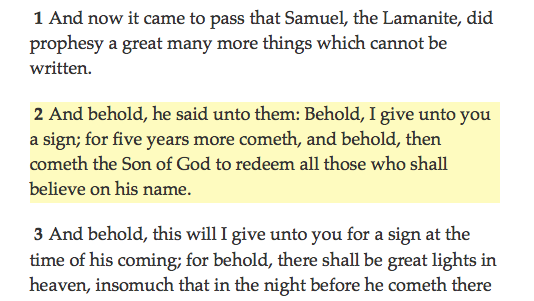

Why would this be? The answer could be as simple as this: Joseph Smith didn't know how he was going to bring about the advent of Jesus in the Americas during the earlier stages of writing The Book of Mormon, but by the time he finished up Moroni and went back to replace the missing 116 pages of manuscript with what became 1 Nephi through Words of Mormon he had the whole thing figured out and could include all the appropriate prophetic details.

Sound doubtful? Good. Doubt your heart out!

Thursday, May 15, 2014

The Lehites' neighbors

You know what would really help us in our search for Book of Mormon lands? The names a few neighboring peoples. We all know that the America's have been populated by human beings for at least the past 15000 years, so why don't we have any mention of these first inhabitants in the records of the Jaredites, or the Lehites, or the Mulekites. We get all manner of "-ites" deriving from these three sets of settlers, but no manner of neighbor.

The LDS Church has currently decided to take the stance that the Book of Mormon peoples integrated extensively with the populations already in the Americas to the extent that virtually all Near Eastern DNA markers have disappeared somehow.


All it would have taken to clear up this whole mess would have been a mere name of a tribe or two, even a verifiable name or two of individuals of an origin other than Jaredite, Lehite, or Mulekite. Just one. Anything to match up with what scholars know about pre-Contact peoples.

It's just hard to take The Book of Mormon seriously when there are holes this big running throughout its supposed history of 2200 BCE - 400 CE.

Wednesday, May 14, 2014

Lehi's land of inheritance

I grew up in a time when the LDS Church was saying that the Nephites and Lamanites once lived throughout North and South America. North America was "the land northward," South America was "the land southward," and the isthmus of Panama was "the narrow neck of land" spoken of in The Book of Mormon. By the time I got to seminary discussions about Book of Mormon geography was a little more vague. We were shown an unbiased rendering of the geography described that looked like this:


So pretty much the Church was still teaching that The Book of Mormon characters were living just north and south of the isthmus of Panama. Latin Americans were Lamanites to us then.

Currently this North/Central America-South America configuration (a.k.a. the hemispheric models) have fallen out of favor and have been replaced by limited geography models. The most popular camp has set its sights on the pyramid-building peoples of Mesoamerica and are proposing maps such as this one:


Far less popular but still a notable second are the theories placing the main events of The Book of Mormon in the American heartland.


Not too far from those theories are the ones who look to the Great Lakes area where Joseph lived and where the gold plates were discovered.


One advantage to this last map is that it actually corresponds nicely with a number of towns Joseph Smith would have heard about or potentially seen on a map.


Hey, if the shoe fits...

The fact is we have no facts other than the claims Joseph made. Now, as time buries brother Joseph ever deeper and people seek facts through science rather than visions, our knowledge of where this whole "ancient history" might be sinks farther and farther into speculation.

Monday, May 5, 2014

Scriptural errors

"And now, if there are faults they are the mistakes of men; wherefore, condemn not the things of God, that ye may be found spotless at the judgment-seat of Christ." (Title page of The Book of Mormon)

This would be a great "Get out of jail free card" for the ancient writers of The Book of Mormon if the faults and mistakes in their writings were not the same faults and mistakes of the translators of the King James Bible.


The Book of Mormon repeats verbatim the mistranslated words, it often keeps the non-textual words and phrases added by KJT translators, it promotes  misunderstandings of the Bible popular in Joseph Smith's time, and it doesn't even align with the "inspired" corrections of the JST.


To suggest that the Lehite prophets possessed the KJT is absurd. To suggest that God filled Joseph's illuminated translating mind with the texts he was already familiar with instead of giving him the actual translation of the gold plates defeats the purpose of bringing out new and improved scripture.

We need to think about this a little bit. If a student turns in homework with the same mistakes as another student, what is the teacher to think? If Thomas Monson came out tomorrow with a new book of freshly translated ancient scripture from Australia and a large part of it quoted verbatim sections from the Doctrine & Covenants and, say, the Book of Enoch, how would we feel about that?

Saturday, May 3, 2014

Isaiah and the Book of Mormon

Deutero-Isaiah (or is this one Trito?) writing about Jesus. 

If the fact that Isaiah was written by more than one person isn't enough to bring on at least a little doubt, consider this fact: anything from Isaiah chapters 40-66 that made it into The Book of Mormon either verbatim, slightly altered, or paraphrased (1 Nephi 10:8, 13:37, 17:36, 20-21, 22:8 & 10-11; 2 Nephi 6:6-7 & 16-18, 7-8, 9:50-51, 10:9, 26:25; Mosiah 12:21-24, 14, 15:10-11 & 14-18 & 29-31; 3 Nephi 16:18-20, 21:8-10 & 29, 22; Moroni 10:31) was written after Lehi & Co. left Jerusalem. So how the hell did they make it onto the brass plates and over to the New World?

You could doubt the authorship of The Book of Mormon at this point if you wanted to. Or you could simply doubt the scholarly understanding that Isaiah was written by multiple authors on into the years following Lehi's departure. After all, we know that The Book of Mormon is true and that "the wisdom of this world is foolishness" (1 Corinthians 3:19).

Problem solved! Except there's still the whole plagiarism thing you have to consider too...