Showing posts with label dishonesty. Show all posts

Tuesday, August 18, 2015

Hiding history

 
The media are reporting a celebration of a new era of LDS Church transparency with the release of The Joseph Smith Papers and, more recently, the printer's copy of The Book of Mormon. I can't disagree that the move to transparency is a good thing in that it's the most honest thing for the Church to do, but in the midst of all the celebrating I feel as though a lot of members are choosing to ignore what's to be celebrated. We're not celebrating new scripture, new revelations or even new propaganda for the missionaries to hand out. We're celebrating an end of the Church's suppression of information in one very specific area - it's early historical documents.
 

The two most infamous examples of previous attempts on behalf of the Church to keep historical information away from members include the Mark Hofmann forgeries and, earlier still, Joseph Fielding Smith's hiding of Joseph Smith’s 1832 version of the First Vision. Joseph Fielding had first discovered it in the First Presidency vault in Joseph Smith's personal letter book, freaked out about it enough to tear it out and hide the pages in his personal safe until he was pressured to release them in 1965. How messed up is that?


I'll admit I can't imagine what incentive he might have to share the first written version of the First Vision (it doesn't match well with the 1838 version), but his behavior is still alarming to me. Sure, it shows Joseph Fielding's lack of integrity, but it also shows just how fearful he was that the LDS house of cards would fall.


Now the Church is announcing via the Ensign and Liahona that Joseph Smith read magically appearing words on a stone in a hat and that that particular stone had nothing to do with an ancient Moroni, but that instead it has everything to do with a young Joseph Smith pretending he could see lost and buried objects (like gold). It's been 180 years and the general membership is only going to hear about it now (if they actually read the Liahona). Avoidance and denial add up to secrecy and deception in my brain.

Wednesday, August 12, 2015

LDS FAQ - "Masonry and the Temple"

I found a brief Church-sanctioned (I believe) explanation of the LDS temple's relationship to Freemasonry. I'm curious what it says. Text found here.


Students of both Mormonism and Freemasonry have pondered possible relationships between Masonic rites and the LDS temple ceremony. Although some argue that Joseph Smith borrowed elements of Freemasonry in developing the temple ceremony, the Endowment is more congruous with LDS scriptures (especially the book of Abraham and the Book of Moses) and ancient ritual than with Freemasonry. Both the book of Abraham and the Book of Moses are texts Joseph made up out of thin air, so I personally don't see why anyone would feel better knowing that they've influenced the creation of the LDS temple ceremonies. Pointing out that the temple has more more in common with those writings than with Freemasonry still doesn't justify the presence of Masonic oaths and handshakes in the temple. Latter-day Saints view the ordinances as a revealed restoration of ancient temple ceremony and only incidentally related to Freemasonry. There's no good reason to think the LDS temple ceremonies are ancient and I'm looking forward to seeing how you continue to downplay the influence of Freemasonry. The two are not antithetical, however, nor do they threaten each other, and neither institution discourages research regarding the ancient origins of their two ceremonies. The origins of Freemasonry are not ancient at all, they are medieval, late medieval. Many sacred ceremonies existed in the ancient world. Modified over centuries, these rituals existed in some form among ancient Egyptians, Coptic Christians, Israelites, and Masons, and in the Catholic and Protestant liturgies. Is this written for 6th graders? I can't believe you dared list the Masons in this group. And Egyptians? WTF? Which Egyptians are you talking about? Common elements include the wearing of special clothing, ritualistic speech, the dramatization of archetypal themes, instruction, and the use of symbolic gestures. Levi Strauss would be so proud to read this, but aren't these elements too broad to be taken seriously in this particular discussion of Freemasonry in the LDS temple? One theme common to many—found in the Egyptian Book of the Dead, the Egyptian pyramid texts, and Coptic prayer circles, for example—is man's journey through life and his quest, following death, to successfully pass the sentinels guarding the entrance to eternal bliss with the gods. Right, Thor and all his buddies in Valhalla. Though these ceremonies vary greatly, significant common points raise the possibility of a common remote source. Human psychology most likely. Mormon wishful thinking knows no ends.


The Egyptian pyramid texts, for example, feature six main themes: (1) emphasis on a primordial written document behind the rites; (2) purification (including anointing, lustration, and clothing); (3) the Creation (resurrection and awakening texts); (4) the garden (including tree and ritual meal motifs); (5) travel (protection, a ferryman, and Osirian texts); and (6) ascension (including victory, coronation, admission to heavenly company, and Horus texts). Oh my god, that's so... DIFFERENT from the Mormon temple! Wow. Like such ancient ceremonies, the LDS temple Endowment presents aspects of these themes in figurative terms. Only if you're working in the most sympathetic of generalizations. It, too, presents, not a picture of immediate reality, but a model setting forth the pattern of human life on earth and the divine plan of which it is part. We're going to need some actual details here. It sounds like you're seeing what you want to see. It's called confirmation bias.
 

Masonic ceremonies are also allegorical, depicting life's states—youth, manhood, and old age—each with its associated burdens and challenges, followed by death and hoped-for immortality. The difference between your argument for the temple paralleling an Egyptian Book of Breathings and the Freemason ceremonies is that Joseph actually knew Masons and became one himself. On the other hand, he had no understanding of Egyptian despite having purchased a scroll containing a book of breathings. He feigned a translation that is laughable to today's Egyptologists. There is no universal agreement concerning when Freemasonry began. Maybe not, but no one can seriously claim it pre-dates the late Middle Ages. Some historians trace the order's origin to Solomon, Enoch, or even Adam. Only Mormon historians. Others argue that while some Masonic symbolism may be ancient, as an institution it began in the Middle Ages or later. Only everyone who isn't Mormon thinks this.
 

Though in this dispensation the LDS Endowment dates from Kirtland and Nauvoo, Latter-day Saints believe that temple ordinances are as old as man and that the essentials of the gospel of Jesus Christ, including its necessary ritual and teachings, were first revealed to Adam. Mormons have no basis for believing this other than the fact that Joseph Smith, a notorious conman, taught it to his followers and it has been believed and repeated for generations. These saving principles and ordinances were subsequently revealed to Seth; Noah; Melchizedek; Abraham, and each prophet to whom the priesthood was given, including Peter. There is no historical evidence to convince us most of these men ever existed (Peter is the exception) and much less evidence that they ever practiced the ceremonies of the current LDS temples. Latter-day Saints believe that the ordinances performed in LDS temples today replicate rituals that were part of God's teachings from the beginning. But they have no reason to believe anything similar. Hopefully the author of this article will cite some convincing texts.


The Prophet Joseph Smith suggested that the Endowment and Freemasonry in part emanated from the same ancient spring. Joe Smith? He's not a very trustworthy source. Do you know he tried to trick investors into funding an illegal bank? The man was as phony as a $3 bill. Thus, some Nauvoo Masons thought of the Endowment as a restoration of a ritual only imperfectly preserved in Freemasonry and viewed Joseph Smith as a master of the underlying principles and allegorical symbolism (Heber C. Kimball to Parley P. Pratt, June 17, 1842, Church Archives). I'm sure those few unnamed Freemasons were totally right... The philosophy and major tenets of Freemasonry are not fundamentally incompatible with the teaching, theology, and doctrines of the Latter-day Saints. Obviously not, but that does not mean they derive from ancient biblical patriarchs or that one group did not co-opt them from the other. Both emphasize morality, sacrifice, consecration, and service, and both condemn selfishness, sin, and greed. So what? You're talking about two groups who's morality is founded in Christian European thought. You're also ignoring the fact that essentially every ethnography you'll read will describe cultures who's beliefs include similar concepts and virtues. That says more about human psychology than it does about the LDS temple being ancient. Furthermore, the aim of Masonic ritual is to instruct-to make truth available so that man can follow it.
 

Resemblances between the two rituals are limited to a small proportion of actions and words; indeed, some find that the LDS Endowment has more similarities with the Pyramid texts and the Coptic documents than with Freemasonry. At this point, dear reader you should compare and contrast the text shared between the temple endowment and the Mason ceremonies. They are in many cases identical! Even if we are to accept the author's claim that they only make up a "limited" portion of the temple, that DOES NOT justify their presence in temple liturgy. I would love to see where the endowment plagiarizes Coptic liturgy in the way. Even where the two rituals share symbolism, the fabric of meanings is different. Because Joseph took the symbols and recast them for his own purposes. In addition to creation and life themes, one similarity is that both call for the participants to make covenants. You keep dancing around the details. I find this approach willfully dishonest. Yet, the Endowment alone ties covenants to eternal blessings and to Jesus Christ. How did you reach this conclusion? Your argument is "OK, we have similarities, but ours is legit, theirs isn't, trust me!"? I'm not impressed. The Masonic ceremony does not emphasize priesthood or the need to be commissioned by God to represent him. So whoever emphasizes that the most wins? What kind of moronic game are you playing? The active participation of God in the world and in men's lives is a distinctly LDS temple motif. As is God's active participation with women, but only through men. It's called divine sexism. While Masons believe in an undefined, impersonal God, everything in the LDS Endowment emanates from, or is directed to, God who is a personage and man's eternal Father. That doesn't mean Joseph Smith didn't steal the Masonic rituals and infuse them into his own thought. The Endowment looks to the eternities and to eternal lives, but Freemasonry is earthbound, pervaded by human legend and hope for something better. Because Joseph had to outdo everyone, including himself.


Freemasonry is a fraternal society, and in its ritual all promises, oaths, and agreements are made between members. In the temple Endowment all covenants are between the individual and God. You finally seem to be admitting they use the same oaths (which they do), even if directed to different entities. In Freemasonry, testing, grading, penalizing, or sentencing accords with the rules of the fraternity or membership votes. In the Endowment, God alone is the judge. You lost me. Do you mean that the Freemasons actually take quality control seriously while Mormons just let anything go in the temple? That's dishonest. In the Mormon temple you have someone checking on you every step of the way making sure you do everything just right. The difference being that Freemasons have to learn everything by heart and then get tested, whereas Mormons get to copy what's shown to them on the spot. Within Freemasonry, rank and promotions are of great importance, while in the LDS temple rites there are no distinctions: all participants stand equal before God. Not really. Men and women have separate seating and gendered clothing, including a veil to cover the faces of women. Husbands are placed over wives in the temple. Men get to become king and priests and women queens and priestesses. Historically kings ruled over their queens and we have no idea what a priestess even does according to Mormon doctrine. This is not equality. The clash between good and evil, including Satan's role, is essential to, and vividly depicted in, the Endowment, but is largely absent from Masonic rites. So Joseph added a maniacal Satan to the stage, so what? This is a red herring. You need to look at the details you so diligently avoid! That's where you'll find the real devil. Temple ceremonies emphasize salvation for the dead through vicarious ordinance work, such as baptism for the dead; nothing in Masonic ritual allows for proxies acting on behalf of the dead. Because it's a ridiculous notion. Why would a fraternity need to induct the deceased? Women participate in all aspects of LDS temple rites; though Freemasonry has women's auxiliaries, Masonic ritual excludes them. Freemasonry is a men's club, just like the LDS endowment was back when it was introduced. Both have changed (Mormonism first, thanks to polygamy) to be more inclusive of women. The Endowment's inclusion of females underscores perhaps the most fundamental difference between the two rites: LDS temple rites unite husbands and wives, and their children, in eternal families (see Eternal Lives; Marriage). Now you've moved away from the endowment, where the Masonic plagiarism is found, to the sealing room. You've just moved the goal posts, moron. Latter-day Saint sealings would be completely out of place in the context of Masonic ceremonies. Incredible. I almost want to give you points for trying, except I feel like you're purposefully being sloppy in your analysis of Freemasonry and the LDS temple. I don't know if you're being dishonest or if you simply don't know what you're doing.
 

Freemasonry's 5 points of contact as used in the LDS temple endowment until 1990.

Thus, Latter-day Saints see their temple ordinances as fundamentally different from Masonic and other rituals and think of similarities as remnants from an ancient original. This conclusion is only reached by ignoring the verbatim theft of oaths, the co-opting of symbols, the exact copying of handshakes, and many other elements, while simultaneously cherry picking cultures to compare your beliefs to and then staying back in the vaguest of generalities in order to avoid seeing your comparison implode.

KENNETH W. GODFREY should be ashamed of himself.

Sunday, August 9, 2015

Temple prep - Endowed from on High "Lesson 4"

I'm reading the Church Education System's manual for temple preparation and adding my two cents. Text found here.

Objective

“And without the ordinances thereof, and the authority of the priesthood, the power of godliness is not manifest unto men in the flesh” (D&C 84:21). Isn't God (and the power of godliness) evident to "men in the flesh" through all of Creation regardless of priesthood authority and ordinances? The Book of Mormon strongly suggests that he is and all we really have to do to observe this power is observe the stars and planets (Alma 30:40-41, 44).
To help class members understand the importance of temple ordinances and covenants. This lesson is totally for me. If there's one thing I can claim to not understand about the temple it's its importance to a Christian God. But somehow I doubt this lesson will be of much help...

Preparation

  1. If it is available in your area, you may want to show the video presentation Together Forever. Yet another super-sentimental video from the '80s? This trash is emotional manipulation for the hyper-sensitive. The presentation lasts approximately 27 minutes. 27 minutes of stiff scripted and poorly acted religious goop. Pure torture (except for the bad boy in a sports car 12 min. in).
  2. You may want to prepare to have the class members sing “More Holiness Give Me” (Hymns, no. 131). That's a great song who's message can be summed up as: "More more more, now now now. I'm a worthless god dropping. Amen."

Lesson Presentation

Ask class members if they have any questions. About what? You haven't even introduced the topic yet, so unless these kids have read something on their own (from the Internet, say) they won't have anything to ask. Take the time required to answer questions to the best of your ability and as guided by the Lord’s Spirit. Fine. I have a question for you to answer by the Spirit. Why do we no longer speak Adamic in the prayer circle? Why would the Lord reveal that special language and then tell us we're not supposed to use it anymore? Did we piss of God in the late '80s somehow? Remember that some aspects of temple work must not be discussed outside the temple. Adamic is no longer part of the temple ceremony so can we talk about it?

In the Temple We Receive Ordinances and Make Covenants

Explain that in the temple we receive the ordinances that will enable us to return to the presence of God. Kids, these are handshakes and oaths taken directly from the Freemasons and modified in some cases by Joseph Smith. We also make covenants to live the laws of the gospel. Didn't we already do that at baptism and every week after in sacrament meeting? The following material will provide information about ordinances and covenants in general, and temple ordinances and covenants in particular. Ooh! Particulars!

Ordinances

Explain that an ordinance is a sacred ceremony that has a spiritual meaning and effect. We learned this long before we were baptized.
Ask the class members to name some of the ordinances in the Church. (They may mention naming and blessing of babies, baptism, confirmation, the sacrament, ordination to the priesthood, and temple ordinances.) Well they can't really name the temple ordinances because they probably don't know what they are. They might mention anointing the sick and dedicating graves. Magical healing lube and sanctifying holes in the ground are important!
Explain that ordinances performed by the power of the priesthood are essential to our exaltation. I think Jesus would say that baptism and the sacrament are essential. He didn't talk about the other stuff as essential, if he talked about it at all. It is through these ordinances that we receive the power of God in our lives. Jump through the hoops and God gives you one of his lightning bolts to play with.
 

Ask the class members to read Doctrine and Covenants 84:19–21.
  • What is necessary in order for the power of godliness to be manifest in our lives? (The ordinances of the Melchizedek Priesthood. The “greater priesthood” mentioned in these verses is the Melchizedek Priesthood.) This doesn't make sense at all. What about those verses in Alma I linked us to above? They say that God's power is manifest through all things. The New Testament says that God makes it rain on rich and poor. My understanding is that everyone is constantly witnessing God's power everyday regardless of who we are. Does God not bless people who aren't baptized LDS? Does he not answer their prayers? Does he not work through them?
“We covenant to give of our resources in time and money and talent—all we are and all we possess—to the interest of the kingdom of God upon the earth” (Preparing to Enter the Holy Temple, 35). So rewrite my wills, kids. The LDS Church gets it all.
Have class members turn to page 29 in Preparing to Enter the Holy Temple. Ask a class member to read the following statement aloud:
“How important are the ordinances to us as members of the Church? The real question is "How important are these ordinances to Jesus?" Probably not very. He never really talked about them.
“Can you be happy, can you be redeemed, can you be exalted without them? Answer: They are more than advisable or desirable, or even than necessary. More even than essential or vital. They are crucial to each of us.” "Necessary", "essential", "vital" and "crucial" are synonyms. Your rhetoric is weak.

Covenants

Emphasize that a covenant is a sacred agreement between God and a person or group of people. More rehash of baptismal prep. I promise we all get it at this point. God sets specific conditions, and He promises to bless us as we obey those conditions. The conditions are pretty rigid and the blessings are extremely suspicious. God's stacked things in his favor. When we choose not to keep covenants, we cannot receive the blessings, and in some instances we suffer a penalty as a consequence of our disobedience. Before 1990 the penalties LDS Mormons were covenanting to involved slitting throats, slashing chests open and disembowelment. Fortunately that was all rhetorical and not literal. Still gross though. The saving ordinances of the priesthood are always accompanied by covenants. Because God can't help you unless you dress in white and get dipped in water or whatever. He's got to know you're in it to win it! #powerofhazing
  • What covenants have you made with the Lord up to this point in your lives? (Class members may mention the covenant of baptism, which is renewed each time we take the sacrament.) That just about covers it. They haven't made other covenants and Jesus didn't ask for any more.
  • What covenants do we make when we are baptized? (See Mosiah 18:8–10; D&C 20:37.) To call ourselves Jesus' people, share hardships, show empathy and generosity to others, tell everyone that God is great, serve God always and show others you do indeed serve him (best done by feeding the hungry, clothing the naked and healing the sick).
Emphasize that when we make covenants with God, we express our desire to serve God and our willingness to obey all that is asked of us. Trying to express that desire through any other means just doesn't convince the Lord. You have to play by his arbitrary rules. In return, God promises us many wonderful blessings. Ugh! More "blessings". This is just shorthand for "trust us". We must make and keep covenants in order to progress toward eternal life. And one of those covenants, ladies, is that you will obey your husband. I'm not kidding. Apparently unless you "harken unto" your righteous husband, you'll be blocked at the pearly gates.

Temple Ordinances and Covenants

Explain that the temple ordinances include the endowment and sealings (temple marriage and sealing of parents to children) for both the living and the dead. I'm guessing everyone in the class already knows this. Why don't we explain instead what the endowment looks like and how sealings began as polygamous unions, not monogamous ones. The ordinance of baptism for the dead is performed in temples, as are other priesthood ordinances. Jews hate that whole baptism for the dead thing, as do many other people who don't want Mormons trying to convert their ancestors. In the temple ordinances, we make solemn covenants to give ourselves to God and to help build His kingdom on earth. I think you mean "at baptism". The temple is sounding redundant.
Elder James E. Talmage said about the covenants we make in the endowment:
“The ordinances of the endowment embody certain obligations on the part of the individual, such as covenant and promise to observe the law of strict virtue and chastity, to be charitable, benevolent, tolerant and pure; to devote both talent and material means to the spread of truth and the uplifting of the race; to maintain devotion to the cause of truth; and to seek in every way to contribute to the great preparation that the earth may be made ready to receive her King,—the Lord Jesus Christ. Thank you very much for the list, I just have a question for you: how are these not covered in the baptismal covenants? I think they're already covered. With the taking of each covenant and the assuming of each obligation a promised blessing is pronounced, contingent upon the faithful observance of the conditions” (The House of the Lord, rev. ed. [1976], 84). What blessings? List some that are actually convincing. I can tell everyone what you hear in the temple. The gods promise they "will provide a Savior for you, whereby you may come back into our presence, and with us partake of Eternal Life and exaltation". Part of this partaking of "Eternal Life and exaltation" includes "the day... when you will be... Kings and Queens, Priests and Priestesses" in heaven. It sounds impressive, doesn't it?
You may want to review the covenants just described by writing them on the chalkboard. I guess, but where are the actual temple covenants to be found? Why can't temple preppers see them in advance? Emphasize that we make covenants to be righteous and pure, and we also make covenants to give all we have to building the Lord’s kingdom. Tithing isn't enough. The LDS Church wants all you money. Read the following statement:
“We are a covenant people. We covenant to give of our resources in time and money and talent—all we are and all we possess—to the interest of the kingdom of God upon the earth” (Preparing to Enter the Holy Temple, 35). God knows when you're holding back and it really pisses him off! No hiding cash in your mattress, no putting meetings of personal importance over church meetings, no pretending you don't know how to play the trumpet. You've promised it all to God.
  • In what ways can we give “all we are and all we possess” to the kingdom of God? Stop spending money on vacations and eating out and start giving that money to the Church. Make sure we properly indoctrinate out children to think that our family is happy because and only because of Church doctrine. That's for starters.
  • What sometimes hinders members from giving all that they have to the Lord’s kingdom? Needing to buy food for yourself. Believing that the poor and sick could use the money more.

You may want to share your testimony about the blessings that have come into your life because you have made and kept temple covenants. Feel free to say anything you want here no matter how ridiculous it sounds. Tell students that you always grow beautiful carrots in you garden thanks to your temple covenants. Tell them that you've never once had to dip into your year supply of food because you always make sure spend generous amounts of time in the temple. You can seriously say anything and say it's because of the temple. Or you may want to ask another endowed person to share his or her testimony. Sometimes making up blessings can be rather fatiguing or make you feel a bit dishonest so it's nice to pass that task on to someone else.

We Must Be Faithful to the Covenants We Make in the Temple

Explain that the Lord said, “Unto whomsoever much is given, of him shall be much required” (Luke 12:48). And yet the Church maintains a flat 10% on all of its members for some reason. It's time to raise tithing on the rich.
  • How do you think this verse applies to the covenants we make in the temple? It has nothing to do with those covenants. They didn't even exist back in New Testament times. What this has to do with is the way servants behave when their master is away. If they know what their master wants, they should do it; if they don't know and don't do, they should still get beaten up a bit. Not exactly to most moral of lessons.
Explain that the Lord has provided temple ordinances and covenants so that His children can understand the purpose of this life and be prepared for the glorious opportunities of eternal life. This is ridiculous. Every LDS child is taught the "purpose of life" well before they can even pronounce the words let alone comprehend them. We're so saturated with the plan of salvation by the age of 4, we actually think it makes sense. When we receive these blessings, we become accountable to live worthy of our increased knowledge and opportunities. You've learned little to nothing (a secret name, the discomfort of garments, some Freemasonry and a new format for group prayer) and the increased opportunities are delusional. Do we honestly think knowing the Sure Sign of the Nail is going to unlock another level of heaven to us? Please. Emphasize that we must be faithful to the covenants made in the temple.
  • Why is it so important to be faithful to the covenants we make in the temple? Because you just said we must be. Because if we're not we won't get the, um... "blessings"? Because if we stop wearing garments we'll lose our divine fire insurance? Because if we turn on our temple covenants God will ship us off to live with Satan in Outer Darkness? What's the answer?
Ask the class members to read Doctrine and Covenants 82:10. Ah! Because God will cut us loose! Scary!
President Joseph Fielding Smith said: “I say unto you the Lord is not bound, unless you keep the covenant. God already said that in D&C. The Lord never breaks his covenant. Just look at rainbows! We haven't had a global flood since Noah! Why? Because the Lord keeps his word. When he makes a covenant with one of us, he will not break it. Hopefully. I mean he's God, he can do what he wants. If it is going to be broken, we will break it. Remember, it is ALWAYS YOUR FAULT. YOU are always the problem. But when it is broken, he is under no obligation to give us the blessing, and we shall not receive it” Call it tough love, but it's sill love. (Doctrines of Salvation, comp. Bruce R. McConkie, 3 vols. [1954–56], 2:256–57).
“I, the Lord, am bound when ye do what I say; but when ye do not what I say, ye have no promise” (D&C 82:10). Yes, repeat it! Plant it deep into their loamy gray matter!

Faithfulness to Our Covenants Will Bring Peace and Safety

Explain that the temple is a place of peace and a sanctuary in a troubled world. In this sanctuary you will be herded blindly (your first time) into threatening talk of Satan and discussions about how evil the world is. Very peaceful stuff. :S As we attend the temple regularly and are faithful to our covenants, we will find peace, safety, and direction in our lives. Unless, of course, you don't. Some people find the temple troubling and meaningless. We wonder why the Church still practices Joseph's version of temple worship.
Elder Neal A. Maxwell said, “If we will keep our covenants, the covenants will keep us spiritually safe” (in Conference Report, Apr. 1987, 87; or Ensign, May 1987, 71). In other words, watch yourselves or Satan will get you!
  • In what ways have the covenants you have made thus far helped to keep you spiritually safe? I was taught that getting baptized and receiving the gift of the Holy Ghost was going to keep me straight, but I could never sort out when it was influencing me. What I'm saying is that I don't believe I have been kept safe.

Point out that in the temple we covenant to live worthy to return to the presence of Heavenly Father and Jesus Christ. Which you've already done at baptism. Sometimes, in the midst of our daily struggles, we may wonder if such living is possible. Only if we're constantly repenting for being weak, stupid beings who need to be bathed in god blood.
Ask the class members to read 1 Nephi 17:3, 13.
  • What do these scriptures teach about how the Lord will help as we strive to return to Him? They didn't say anything about how to keep the commandments or if it's even possible as imperfect beings, they just say that if we do God will lead us. How have you seen these scriptures fulfilled in your life? I haven't. I prayed several times a day to be lead by God as a missionary and mostly talked to crazy people. It was very frustrating. Apart from missionary work, it doesn't seem I needed much direction from God. Life was always good for me. I still sought it fervently with no success.
Elder Boyd K. Packer said: “When you come to the temple and receive your endowment, and kneel at the altar and be sealed, you can live an ordinary life and be an ordinary soul—struggling against temptation, failing and repenting, and failing again and repenting, but always determined to keep your covenants. In fact, keep feeling like a failure in need of repentance your whole life because that way you'll be more likely to keep attending church. … Then the day will come when you will receive the benediction: ‘Well done, thou good and faithful servant: thou hast been faithful over a few things, I will make thee ruler over many things; enter thou into the joy of thy lord’ (Matthew 25:21)” (Let Not Your Heart Be Troubled [1991], 257). Never stop believing that. This is one imaginary carrot you're going to catch!
President Howard W. Hunter invited us to go to the temple often “for the personal blessing of temple worship, for the sanctity and safety which is provided within those hallowed and consecrated walls. "Blessing blessing blessing!" It's a blessing you're spending hours in a quiet earthquake proof building. You have less of a chance of being in a building that will collapse on you. The temple is a place of beauty, it is a place of revelation, it is a place of peace. But not for everyone. Some find its aesthetic to be in bad taste, its teachings to be jarringly stupid, and the general vibe extremely unsettling. It is the house of the Lord. Don't trip on his shoes on your way in. It is holy unto the Lord. Trust us. God loves veiled women. It should be holy unto us” Whatever God likes we need to like too. (quoted in Jay M. Todd, “President Howard W. Hunter,” Ensign, July 1994, 5).

Conclusion

Ask class members to share their feelings about the blessings of receiving the temple ordinances and making covenants with Heavenly Father. How can they when they haven't been through the temple and received those "blessings"? Are you asking how they feel about the idea of getting blessed for participating in temple ceremonies? I feel like God has to have some serious issues if he can only bless his children if they sit through these absurd temple ordinances (which have not even been detailed yet - and this lesson promised particulars!). I also feel like baptism by proper authority is only slightly less absurd. I feel like an all loving god could have set up a much more better system for teaching his billions of children.
If time permits and the video presentation Together Forever is available in your area, you may want to show the presentation. You do not want to watch this video. It's godawful.
Bear testimony about the blessings of receiving the temple ordinances and the privilege of entering into covenants with Heavenly Father. You already did this earlier in the lesson so just say with quiver in your voice and a tear in your eye that you KNOW! Heavenly Father wants to bless us so badly and WILL! if we humbly seek to make and keep the sacred temple covenants! No further testifying is necessary. Thank you.

Sunday, July 12, 2015

Temple prep - "Worthy to Enter"

The following text is taken from the pamphlet "Preparing to Enter the Holy Temple" (2002) and annotated by me.


Once you have some feeling for the value of temple blessings and for the sacredness of the ordinances performed in the temple, you would be hesitant to question the high standards set by the Lord for entrance into the holy temple. All the Church offers is feelings about so-called blessings and sacredness. It would really be fantastic if someone would lay it all out for us to work through. But the Church isn't doing that right now. Instead we get semi-threatening language about how we "would be hesitant to question" this whole temple thing.

You must possess a current recommend to be admitted to the temple. We know. This recommend must be signed by the bishop of your ward and the president of your stake. OK. Sounds serious... In the mission field, of course, the branch president and the mission president have responsibility for issuing temple recommends. Of course. Only those who are worthy should go to the temple. But a lot of unworthy assholes who shouldn't do too! :( Why can't the bishop and stake president sniff them out? The bishop has the responsibility of making inquiries into our personal worthiness. This interview is of great importance to you as a member of the Church, for it is an occasion to explore with an ordained servant of the Lord the pattern of your life. Ordained but untrained. Let's tell it like it is: this is an obligatory disclosure of your life to that one neighbor dude. If anything is amiss in your life, the bishop will be able to help you resolve it. Well he'll try anyway. Let's not forget that he likely has no training in counseling. Through this procedure, as you counsel with the common judge in Israel, you can declare or can be helped to establish your worthiness to enter the temple with the Lord’s approval. Bishop's approval. The Lord doesn't sign your recommend.

President N. Eldon Tanner, who served as First Counselor in the First Presidency, spoke to the general priesthood meeting about interviews. His counsel has meaning both for the Church leaders who conduct the interview and for the members who are to be interviewed. Consider carefully this counsel:
You bishops and stake presidents might approach an interview for a temple recommend something like this:
“You have come to me for a recommend to enter the temple. I have the responsibility of representing the Lord in interviewing you. What a humble approach. :S At the conclusion of the interview there is provision for me to sign your recommend; but mine is not the only important signature on your recommend. Before the recommend is valid, you must sign it yourself. Sounds tricky! :S
“When you sign your recommend, you make a commitment to the Lord that you are worthy of the privileges granted to those who hold such a recommend. When did Jesus ask us to sign a piece of paper? There are several standard questions that I will ask. … You are to respond honestly to each one.” Because you can tell? …
Now, after you have put those required questions to the applicant, you may wish to add something like this: “One who goes into the house of the Lord must be free from any unclean, unholy, impure, or unnatural practice.” Wait! What are the questions? Is this a pop quiz or can we see the questions? …
Our interviews must be conducted in love, in modesty. Try by conducting them as a friend instead of pretending you're standing in for Jesus. Ofttimes things can be corrected if you ask: “Would there be a reason you may feel uncomfortable or perhaps even dishonest to the Lord if you were to sign your own temple recommend? Dig up the guilt, brother! DIG!! You might want to start using an E-meter.

“Would you like a little time to get some very personal things in order before you sign it? Remember, the Lord knows all things and will not be mocked. YES! Scare them! Terrify them! God will smite them if they're lying! We are trying to help you. Never lie to try to obtain a call, a recommend, or a blessing from the Lord.” Excellent! Passively accuse them of lying! Very good approach.
If you approach the matter as outlined above, the member has the responsibility to interview himself. Because there's not way providing members with the questions and asking them to prayerfully consider their answers on their own would get them to answer honestly. The bishop or stake president has the right to the power of discernment. He will know whether or not there is something amiss that ought to be settled before a recommend is issued. Except when they don't (which is almost always). (“The Blessing of Church Interviews,” Ensign [November 1978]: 42–43.)
The interview for a temple recommend is conducted privately between the bishop and the Church member concerned. (Or the stake president.) Here the member is asked searching questions about his or her personal conduct, worthiness, and loyalty to the Church and its officers. Searching that members could do on their own. The bishop can butt out. The person must certify that he or she is morally clean and is keeping the Word of Wisdom, paying a full tithing, living in harmony with the teachings of the Church, and not maintaining any affiliation or sympathy with apostate groups. Whoa! You basically gave us the questions! Thank you! Can we talk a bit about these topics? Does "morally clean" include faking it until we make it? Does proof that we keep the word of wisdom involve checking how much meat we eat or a test to see if we can "walk and not faint"? Is a full tithe based on gross, net or expendable income? Does these mean we have to actively oppose gay rights? Do we have to avoid our cousins and siblings who have left the Church and always attend Sunstone and Dialog conferences? The bishop is instructed that confidentiality in handling these matters with each interviewee is of the utmost importance. And we just kind of trust them.

Acceptable answers to the bishop’s questions will ordinarily establish the worthiness of an individual to receive a temple recommend. But they don't always have the power of discernment. If an applicant is not keeping the commandments or there is something unsettled about his or her life that needs putting in order, it will be necessary for that individual to demonstrate true repentance before a temple recommend is issued. Typically that demonstration takes the form of public shaming in the form of not being able to take the sacrament on Sundays or privately in the form of paying up on tithing.

After the bishop has conducted such an interview, a member of the stake presidency likewise interviews each of us before we go to the temple. Because bishops don't do a very good job. They really should get some E-meters. If we are going for the first time, ordinarily the stake president personally conducts the interview. Because... why? Is this supposed to be comforting or is it just an arbitrary rule you thought you'd share?

Surely, when you appear to be interviewed for a temple recommend you would accept the judgment of him who is designated as the judge in Israel, who is responsible to represent the Lord in determining whether or not it is proper for you to enter this sacred place. Sure, I guess. Unless he's a total idiot or complete dick. Have you ever heard of the leadership roulette?

Friday, July 10, 2015

Temple Prep - "These Things Are Sacred"

The following text is taken from the pamphlet "Preparing to Enter the Holy Temple" (2002) and annotated by me.


A careful reading of the scriptures reveals that the Lord did not tell all things to all people. No kidding! A handful of patriarchs, a few Israelite prophets here and there, early Christians and now Mormons. The rest of the world got totally screwed and didn't even hear from him. What kind of father would be so inconsistent with his children? "Hey, I have some rules you all better learn to follow, but I'm not telling most of you what they are. Good luck!" From what you've said in one sentence I can already tell I don't like the Lord. There were some qualifications set that were prerequisite to receiving sacred information. Like what? Do explain. Temple ceremonies fall within this category. Says who? Please cite some authority figure (preferably God).

We do not discuss the temple ordinances outside the temples. No one discusses about the temple in the temple either. Fortunately plenty of people feel free to talk about it online. It was never intended that knowledge of these temple ceremonies would be limited to a select few who would be obliged to ensure that others never learn of them. It is quite the opposite, in fact. With great effort we urge every soul to qualify and prepare for the temple experience. Riiiiiight, Mormons are just the gatekeepers who sit and unrighteously judge others to be unworthy. Those who have been to the temple have been taught an ideal: Someday every living soul and every soul who has ever lived shall have the opportunity to hear the gospel and to accept or reject what the temple offers. Too bad the LDS temple wasn't part of Christ's practice - the Jewish temple was. If this opportunity is rejected, the rejection must be on the part of the individual. Why would God set up a system where the VAST MAJORITY of human beings would only hear about Jesus and the LDS temple after they die? It makes no sense.

The ordinances and ceremonies of the temple are simple. They're Masonic and designed to test one's memory. They are beautiful. Beauty lies in the eye of the beholder. They are sacred. Not to the vast majority of people living on earth... They are kept confidential lest they be given to those who are unprepared. No, they're kept confidential because that's the tradition of the Masonic fraternity they come from. Curiosity is not a preparation. Isn't it at least a start? A seed to experiment upon? Deep interest itself is not a preparation. What if that deep interest has led to lots and lots of study? Preparation for the ordinances includes preliminary steps: faith, repentance, baptism, confirmation, worthiness, a maturity and dignity worthy of one who comes invited as a guest into the house of the Lord. Actually faith and baptism are what Jesus asked for, well, and that we give all our money to the poor and love our neighbors like we love ourselves.

We must be prepared before we go to the temple. You said that already. We must be worthy before we go to the temple. You said that too. There are restrictions and conditions set. You said that as well. They were established by the Lord and not by man. Show us where he made these restrictions. Maybe in the Handbook of Instruction Vol. 1? And, the Lord has every right and authority to direct that matters relating to the temple be kept sacred and confidential. I suppose he does, but is this a matter of legal rights? Couldn't we also argue that every man, woman and child has a right to know what God has up his sleeve?
All who are worthy and qualify in every way may enter the temple, there to be introduced to the sacred rites and ordinances. If we can be introduced to baptism before being baptized (including the exact wording of the prayer, the white jumpsuits and practice plugging our nose), why can we not be introduced to other ordinances before we do them?

Temple prep - Preparing to Enter the House of the Lord

This month's issue of the New Era focuses on getting kids excited about taking out their temple endowment. How informative is this form of temple preparation? Text found here.

Kent F. Richards
Smile when you think of the temple. OK! It is a place of power and blessing. Cool. I hope you explain this power and describe these blessings later on.
At a temple open house, I noticed some girls file behind their parents through the temple. They smiled as they found their reflections in brides’ room mirrors. Thrilled at the thought of fulfilling their role as wives and breeders no doubt. “Remember,” their grandmother whispered, “how special you are and how much Heavenly Father loves you.” Says you, Grandma. Heavenly Father's more of the silent type, if you haven't noticed. Each girl imagined the time when she would return to the temple as a woman of faith, with maturing loveliness and capacity, ready to fulfill her mission on the earth. "Maturing loveliness"? Really? You mean boobs and birthing hips? And "her mission on earth" is sexual reproduction, right? How dare you write so disgustingly about teenage girls? Boys who attended the open house also had glimpses of their future blessings and responsibilities. What blessings? What are you talking about? How did you get in these boys' heads exactly? How do you know they were contemplating their "future responsibilities"? And what are those responsibilities? Tithing? Fatherhood? What are you talking about?

What these children felt in the temple was right. You don't even know what they felt, dude. You assume you do. Heavenly Father wants to bless you. How? And why would the temple make that any easier? You do know he's God, right? God can kind of do what he wants. His greatest blessings come as you enter the temple to receive sacred ordinances and to make and keep sacred covenants. What are those blessings? Where does God ever discuss in scripture the nature of the temple and its blessings in detail? Let me tell you: the Old Testament. Do you know what ancient temple worship was like? I'll tell you: nothing like modern LDS temple worship. There was a lot of buying animals, killing them, putting their blood and guts on an alter, and burning incense to cover the smell of slaughter. You are responsible to prepare and be ready. I sure hope you tell us how to do this.
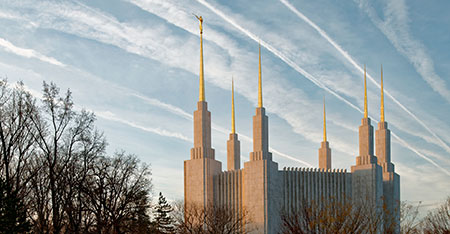
Washington D.C. Temple
The temple is important in your life, especially when you’re young: “The young man needs his place in the temple even more than his father and his grandfather, who are steadied by a life of experience; and the young girl just entering life, needs the spirit, influence and direction that come from participation in the temple ordinances.”1 Sure, if you say so. Can you explain why it's so much more important to the younger generations? I'm not getting it. If the temple ordinances are essential for everyone, how can they be more important for anyone? Begin now to prepare your heart and mind to be able to fully receive and understand these blessings. You already said this...

Receiving the Fulness of the Gospel  

"Fulness of the Gospel" refers to repentance and baptism (see 3 Ne. 11:40). The Book of Mormon is said to contain the "fulness of the Gospel" and it makes no reference to a dramatized temple play about Adam and Eve. The Book of Mormon also says the Bible contains the "fulness of the Gospel" and the Bible also lacks a description of our current LDS temple endowment. Let's be honest and stop pretending that Christ's gospel includes all the Mormon temple weirdness.

If you will prepare yourself to enter the temple, you will be “ready to receive the fulness of [His] gospel” in the temple (D&C 35:12; emphasis added). That verse says nothing about the temple endowment. The temple is a place of power and blessing. The pull quote from above! Let's see if you explain either the power or the blessings... The Lord instructed the Prophet Joseph Smith and the early Saints to gather to Kirtland, Ohio, USA, where they would eventually build a temple. Damn, looks like you preferred to skip the explanation. Oh well. On to the Kirtland temple... Are you insinuating that it was used the same way as today's temples? I hope not. It was more like a stake center and storehouse, and you probably know that. “There you shall be endowed with power from on high” (D&C 38:32; emphasis added). This revelation was given in 1831. When was the endowment introduced? Over a decade later shortly after Joseph Smith had become a Freemason. It's safe to say that the endowment of power mentioned in D&C 38 has nothing to do with the Freemasonry ceremonies the LDS Church later co-opted.

At a recent temple open house, an Apostle gathered his family around the holy altar in a sealing room. He taught them that everything we do in the Church—classes, activities, programs, and meetings—prepares us to come to the temple altar to receive the sealing ordinance. That's so true. Unfortunately for Mormons Jesus never taught it. The temple represents the very essence of your Heavenly Father’s plan for your eternal happiness and progression. If only that plan made any sense.

Preparing to Make Covenants with God

Your preparation to enter the temple and make covenants doesn’t happen quickly. The minimum requirement for an adult convert is a year. That's not very long. It began with your baptism and the confirming gift of the Holy Ghost and then grows with prayer, scripture study, obedience, and service. Actually faith and baptism is really all Jesus ever asked for. If someone does everything you've listed, Jesus would be thrilled. It invites cleanliness weekly as you participate in the sacrament. Partaking of the Lord's supper was about participating in the community of Christians (the body of Christ), not about preparing to dawn a bunch of robes and pretend you're Adam or Eve. It happens as you learn to seek forgiveness through repentance, as you keep standards, and as you worthily carry a limited-use temple recommend. Yes, keeping your Jr. membership card certainly keeps your eye focused on becoming a gold member card carrier. Youth programs will help you, but your preparation is personal; you are developing your worthiness, your testimony, your conversion. How can teens have a testimony of something they've never heard about in their lives? Tell them, please, what happens in the temple! The Savior’s Atonement applies to you personally. Non sequitur.

As you increase your level of spiritual maturity, you will desire to prepare for and enter the temple. Don't confuse maturity for increased gullibility, deeper financial investment and fear of non-conformity, sir. There you will receive ordinances and make covenants, which are necessary steps to draw closer to your Heavenly Father. Which ordinances? Which covenants? Can't you spell them out? Why don't the New Testament and Book of Mormon mention anything besides baptism? Temple ordinances are “the most exalted … ordinances that have been revealed to mankind.”2 You mean revealed to the Freemasons in the late Middle Ages and stolen by Joseph Smith in the 1840s.

As you receive temple ordinances, you make solemn covenants with your Father only one time for yourself, and then you will strive to abide by them throughout your life. Holy cow, you actually kind of said something informative!! Kids, according to Mormon doctrine, you only have to go through once! Each time you enter the temple, you can feel of His Spirit and receive additional revelation and understanding while providing the necessary ordinances for others. What if we don't feel the spirit at all, let alone receive revelation? As for "others", why are we doing the work for people who's names have already gone through the temple many times before? You will understand and receive assurance of your eternal existence and the unending power of your covenants. I didn't. The temple made me feel very unsure of everything and made covenants feel cheap. If we were not eternal beings, the temple would have no significance. You don't know we are eternal. No one does. You may hope and believe we are, but you don't know. If you or anyone else wishes to disagree, please present your evidence. You enter the temple and make covenants because you will exist eternally and want to be with your Heavenly Father and your family in “never-ending happiness” (Mosiah 2:41). Heavenly Father is such a loving dad, right? This assurance grows in your own soul and is confirmed by the Holy Ghost. Unless it doesn't and isn't. What do you have to say to people who made every effort to experience this and didn't?
young woman

Being Worthy

The role of the Holy Ghost is real. He teaches you, purifies you, and conveys the Father’s love (see Romans 5:5). Does he?The Holy Spirit of Promise is the ratifying power of the Holy Ghost, which validates each covenant eternally. How bureaucratic.

In order to receive the Spirit, you must enter the temple clean and pure, free from any unforgiven transgression. Or else what? Your endowment doesn't count? Name one case of an unworthy person's presence being detected. Please explain what happens to the children and grandchildren of a someone who was unworthy at his or her sealing. Do you have answers to these kinds of questions or are you just trying to scare kids into conformity? If the adversary could succeed in any way to overcome you, it would be to keep you from the temple or to entice you to go there unworthily. Satan's very scary like that. What would happen should he succeed? Does the temple cave in on you? Let's lower the stakes now. What happens to the sacrament, for example, when it's blessed by teenage hands that have masturbated only hours before?

For this reason, you will be invited to sit in a personal interview with your bishop or branch president, to consider your worthiness and readiness to receive a recommend to enter the temple. These interviews are the worst, even for kids who have nothing to confess. Not only that, they shouldn't be allowed. Parents, do not let your teens be interviewed alone behind closed doors! Be honest and trust him to help you. Why trust him? He has no professional training. How do we know he's not jerking off like the rest of us? In reality, you are determining your own standing before the Lord (see D&C 109:24). Are you sure you cited the right verse? Yes, it used the word "standing" but that doesn't mean it backs up your point, which wasn't a bad one, by the way. I think it makes a lot of sense to cut out the middle man and take things into your own hands. You will sign your own recommend first. You are witnessing your worthiness before the Lord. 3 No, it's to the bishop and the temple ushers. They say God can see your whole heart and mind, so he wouldn't need to watch you sign your name, would he?

To be worthy does not mean you are perfect yet. It means that your heart is right, that you are living the commandments, and that you desire to be better each day. So if we feel our heart is in the right place (I felt that way), we're living the commandments (I was), and we desire to improve day to day (I certainly did) we can skip the interview? Of course not. God still needs to watch us sign our name for some reason.

Learning from Symbols

In the temple, as in the scriptures, the Lord teaches using symbols. You can find many symbols in the scriptures, such as the rock, the seed, the fruit, the tree of life, and the bread and water of the sacrament (see, for example, 1 Nephi 11; Alma 32; Helaman 5:12). Baptism by immersion symbolizes new life, rebirth, and cleanliness (see Romans 6:3–5). In the temple we all wear white, symbolizing purity, holiness, light, and equality. Wow! You just taught an actual symbol from the temple! Oh wait, that whole white=purity/holiness thing is from baptism (and baby blessings). Nothing new here.

Some symbols in the temple are both physical and spiritual. For example, wearing the garment is a physical daily reminder of the temple covenants and the promised blessings. If respected and honored, the garment protects us from temptations and unrighteous influences. Does it? So it's like a magic Satan shield? Say we're about to steal something, for example, will we suddenly think of our uncomfortable underwear and remember what it means? Never mind, I have a more important question: How is this different from the Gift of the Holy Ghost that we get at confirmation? Isn't he supposed to be prompting us and keeping us from evil all the time? So why in the world do we need garments or an awful script if they're doing the exact same thing?

Each of the temple ordinances is symbolic. And also literal, though. I was physically anointed with oil, brother. A man said the words and touched my naked body. That's literal. I also literally wore some ridiculous clothes on top of my ridiculous garments and was taught about the true robes of the Priesthood and the false Priesthood robes of Satan. It's not just symbolism. “In a sacred ceremony, an individual may be washed and anointed,”4 reminiscent of the kings and priests of ancient Israel being prepared to take their positions (see 1 Samuel 10:1; 16:13). Yeah, but we're also literally being anointed to become kings and priests, queens and priestesses to the most high. That's literal, not symbolic. That's why these ordinances are essential, right? The instruction and covenants in the endowment signify being clothed or invested with additional power and promises from God (see Luke 24:49). Please take a few paragraphs to lay out what we covenant in the temple. Also, this verse has nothing to do with the LDS temple, don't pretend it does. It's dishonest. Perhaps the most beautiful symbol is the sealing ordinance, in which a couple is united in an unbreakable bond which can last through all eternity. So is there a real "unbreakable bond" or is it just symbolic? Most Mormons tend to think they really truly are literally going to be with their families forever when they get sealed.

The promises in the temple are rich and noble. What are they? You still haven't told us. They are the “great favors” and “great blessings” (3 Nephi 10:18) that our Father has reserved for you personally. So I read the verse and it seems like you're implying that we'll personally see Jesus if we go to the temple. Is that what you're saying. You're being extremely vague yet tantalizingly suggestive. So smile when you think of the temple. Smile because we love mystery?

No matter your age, do whatever is necessary to be ready to receive the greatest blessings your Father in Heaven offers to you. And you think that those blessings are found in the enactment of a 2-hour Freemason-inspired dress rehearsal for the Celestial Kingdom? That would be nutty. Oh yeah, how come you haven't mentioned Freemasonry yet?? Trust how it felt when you were a child and sang, “I love to see the temple. I’m going there someday. … I’ll prepare myself while I am young. This is my sacred duty.”5 I felt a lot of things while singing Primary songs. Usually I felt anxious to get home and eat. Later in life I felt uncomfortable hearing children sing those songs. They felt brainwashy, especially "I Love to See the Temple". It can be true for you. Kent, I'm sorry to say this, but you're a shitty salesman. :(

Why Do We Build Temples?

“We must gain some feeling for why we build temples, and why the ordinances are required of us. "Feeling", not understanding? Thereafter we are continually instructed and enlightened on matters of spiritual importance. Do we take classes or have deep discussions in the temple? No, no we do not. It comes line upon line, precept upon precept, until we gain a fullness of light and knowledge. You mean until we see Jesus in the flesh? No, you mean we sit in silence and go through the endowment a bunch of times until we think we have it all figured out. We make up all the addition lines and invent all of the new precepts for ourselves because no one sets us straight. We remain tight-lipped about it all (because it's sacred) and then we die. This becomes a great protection to us—to each of us personally. … What "fullness of light and knowledge" becomes a "great protection"? You haven't explained it, you just insist on it.

“… No work is more spiritually refining. Jesus would very much disagree with you. Try feeding the hungry, clothing the naked and caring for the sick. No work we do gives us more power. This means nothing to your reader because you haven't explained the "power" is or why we need more of it. No work requires a higher standard of righteousness. Not even parenthood? You can be a parent without being endowed.

“Our labors in the temple cover us with a shield and a protection. … More empty words. Please explain yourself.

“… If we will enter into our covenants without reservation or apology, the Lord will protect us. Considering the fact that we almost all enter the temple without any real knowledge of what we'll be doing there, I think it's safe to say that essentially everyone enters without reservation or apology. So what is the Lord protecting us from? We will receive inspiration sufficient for the challenges of life. … This is not true. I received no inspiration that was worth a damn in the temple. None. Maybe I'm the exception...

“So come to the temple—come and claim your blessings.” What blessings? You keep making promises without saying what those promises are.
Preparing to Enter the Holy Temple (booklet, 2002), 37.

Key Points

  • In the temple you receive ordinances essential to your salvation. Only baptism is essential. Read your scriptures.
  • You must enter the temple clean and pure, free from any unforgiven transgression. Or else what?
  • As in the scriptures, many of the teachings and ordinances in the temple are symbolic, allowing you to learn more and more each time you return to the temple. What happens when you run out of symbols? Or when all the symbols mean the same thing? What about all the literal stuff? You didn't really discuss that. In fact, you didn't really discuss anything. This whole article was nothing more than smoke and mirrors. May God have mercy on your dishonest soul.