Showing posts with label anointings. Show all posts

Saturday, July 18, 2015

Temple prep - "All Done in Order"

The following text is taken from the pamphlet "Preparing to Enter the Holy Temple" (2002) and annotated by me.


Following the dramatic events at the Kirtland Temple, difficulties and persecutions required that the Saints move. Wherever they located, the Lord revealed plans to build temples. The Lord just didn't have the foresight to see that the saints would be chased away. He really could have saved time and lives by just telling Joseph to take everyone out to Utah instead of some silly place like Missouri. This was true in both Independence and Far West, Missouri. In this period persecution fell upon the Saints with unprecedented rage and eventually they fled to Nauvoo, Illinois. Nauvoo was clearly not far enough. The Lord should have seen that. Here the revelation came again and the commandment to build a house of the Lord.

The Lord explained that the purpose of the building of the house was to reveal the ordinances. “And verily I say unto you, let this house be built unto my name, that I may reveal mine ordinances therein unto my people; for I deign to reveal unto my church things which have been kept hid from before the foundation of the world, things that pertain to the dispensation of the fulness of times.” (D&C 124:40–41.) Freemasonry was definitely not hidden "from before the foundation of the world" and yet that's what you get in the temple. Weird.

He had mentioned that the temple would be a place for them to conduct “your anointings, and your washings, and your baptisms for the dead, and your solemn assemblies, and your memorials for your sacrifices by the sons of Levi, and for your oracles in your most holy places wherein you receive conversations, and your statutes and judgments, for the beginning of the revelations and foundation of Zion, and for the glory, honor, and endowment of all her municipals, … by the ordinance of my holy house, which my people are always commanded to build unto my holy name.” (D&C 124:39.) If you're an active LDS Mormon, you're probably wondering right now what solemn assemblies, what memorials for "sacrifices by the sons of Levi", what oracles "wherein [we] receive conversations", what statutes and judgments, and what revelations of Zion might mean with regard to the temple. Apparently there should be more to the temple than we now have.

Among the ordinances we perform in the Church are these: baptism, sacrament, naming and blessing of infants, administering to the sick, setting apart to callings in the Church, ordaining to offices. In addition there are higher ordinances, performed in the temples. These include washings, anointings, the endowment, and the sealing ordinance, spoken of generally as temple marriage. Boyd, you left out memorials for sacrifices and conversations with oracles!

How important are the ordinances to us as members of the Church? However important you we as members make them. The real question is "How important are these ordinances to Jesus?" Probably not very. He never really talked about them.

Can you be happy, can you be redeemed, can you be exalted without them? Answer: They are more than advisable or desirable, or even than necessary. More even than essential or vital. They are crucial to each of us. "Necessary", "essential", "vital" and "crucial" are synonyms. Your rhetoric is weak.

The Prophet Joseph Smith said he was frequently asked the question:
“Can we not be saved without going through with all those ordinances, etc.?” I would answer, No, not the fullness of salvation. You have to buy the whole set, folks, not just what Jesus was selling. Jesus said, “There are many mansions in my Father’s house, and I will go and prepare a place for you.” House here named should have been translated kingdom; and any person who is exalted to the highest mansion has to abide a celestial law, and the whole law too. Dude, Joe, you haven't been too good at translating. I'd give it a rest. Would you mind sharing with us where Jesus explained the "celestial law"? (History of The Church of Jesus Christ of Latter-day Saints, ed. B. H. Roberts, 7 vols. [Salt Lake City: The Church of Jesus Christ of Latter-day Saints, 1949], 6:184.)
President Joseph Fielding Smith said:
I do not care what office you hold in this Church, you may be an apostle, you may be a patriarch, a high priest, or anything else, and you cannot receive the fulness of the priesthood unless you go into the temple of the Lord and receive these ordinances of which the prophet speaks. Trust Joseph. He only lied when it saved his skin or made some money. No man can get the fulness of the priesthood outside of the temple of the Lord. Are you suggesting that when we go through the temple both men and women are given the fulness of the Priesthood? Like, even women have total god powers?? (Joseph Fielding Smith, Elijah the Prophet and His Mission [Salt Lake City: Deseret Book Co., 1957], page 46.)
We spoke earlier of the higher ordinances performed in the temple. How can any ordinance be "higher" than another "crucial" ordinance? Can an ordinance out crucial another? These include the endowment. Is the endowment more crucial than the marriage sealing, or are you just giving us a merit badge checklist? To endow is to enrich, to give to another something long lasting and of much worth. The temple endowment ordinances enrich in three ways: (a) The one receiving the ordinance is given power from God. You'll be a totally badass wizard!  “Recipients are endowed with power from on high.” Which powers from on high do we get?? (b) A recipient is also endowed with information and knowledge. Secret passwords and slick handshakes! “They receive an education relative to the Lord’s purposes and plans.” You mean the plan that we all had memorized in Primary? That "Lord's plan"? (Bruce R. McConkie, Mormon Doctrine, 2nd ed. [Salt Lake City: Bookcraft, 1966], page 227.) (c) When sealed at the altar a person is the recipient of glorious blessings, powers, and honors as part of his or her endowment. What blessings, powers and honors? How are we blessed? How are we more powerful? How are we honored?

There are two published definitions or descriptions of the endowment, the first by President Brigham Young:
Let me give you a definition in brief. Your endowment is, to receive all those ordinances in the House of the Lord, which are necessary for you, after you have departed this life, to enable you to walk back to the presence of the Father, passing the angels who stand as sentinels, being able to give them the key words, the signs and tokens, pertaining to the holy Priesthood, and gain your eternal exaltation in spite of earth and hell. Passwords and handshakes open the heavens, kids. That's how God rolls. Oh, and Brigham meant "crucial", not "necessary". (Discourses of Brigham Young, comp. John A. Widtsoe [Salt Lake City: Deseret Book Co., 1971], page 416.)
Elder James E. Talmage described the endowment thus:
The Temple Endowment, as administered in modern temples, comprises instruction relating to the significance and sequence of past dispensations, and the importance of the present as the greatest and grandest era in human history. "Past dispensations" here means back to the first half of the 19th century with a healthy dash of late Mideval Freemasonry. This course of instruction includes a recital of the most prominent events of the creative period, the condition of our first parents in the Garden of Eden, their disobedience and consequent expulsion from that blissful abode, their condition in the lone and dreary world when doomed to live by labor and sweat, the plan of redemption by which the great transgression may be atoned, the period of the great apostasy, the restoration of the Gospel with all its ancient powers and privileges, the absolute and indispensable condition of personal purity and devotion to the right in present life, and a strict compliance with Gospel requirements. This is actually a marginally helpful quote in terms of outlining the endowment (but not nearly as helpful as reading it or watching it online). However, now that we've gone over everything, you don't really have to go to the temple to review it again. Or just take a couple of hours to refresh that whole narrative peacefully at home. (James E. Talmage, The House of the Lord [Salt Lake City: Bookcraft, 1962], pages 99–100; hereafter cited as The House of the Lord.)
This statement from Elder Talmage makes it clear that when you receive your endowments you will receive instruction relative to the purpose and plans of the Lord in creating and peopling the earth. You will be taught what must be done for you to gain exaltation. You've said this before in other sections with these same vague terms.

The blessing of the endowment is required for full exaltation. Don't you mean "crucial"? Earlier you said it was "more than" advisable, desirable, necessary, essential and vital. Does "required" mean all that? Every Latter-day Saint should seek to be worthy of this blessing and to obtain it. Otherwise they're selling themselves short! And saving countless hours of sitting through a lame movie, repeating oaths and promises they've already made in the catch-all covenant of baptism, getting dressed up like a clown, driving and parking, and worrying about why the ceremony is so unenlightening.

The ordinances of washing and anointing are referred to often in the temple as initiatory ordinances. It will be sufficient for our purposes to say only the following: Associated with the endowment are washings and anointings—mostly symbolic in nature, but promising definite, immediate blessings as well as future blessings. This is not very enlightening, Boyd. You really should say what the "definite, immediate blessings" are. You should also be telling us that we will be getting naked (this pamphlet was published before 2005) and touched by a stranger (now you just get gestures of touching while you sit in your new underwear). You should also mention the second anointing.

In connection with these ordinances, in the temple you will be officially clothed in the garment and promised marvelous blessings in connection with it. What marvelous blessings? These are all empty explanations. It is important that you listen carefully as these ordinances are administered and that you try to remember the blessings promised and the conditions upon which they will be realized. For us visual learners it would be useful to see the words.

The sealing ordinance is that ordinance which binds families eternally. Through more magic words while the couple, dressed in Masonic robes, is kneeling at an alter doing the handshakes. Temple marriage is a sealing ordinance. It used to just be for polygamous marriages. When a couple is sealed in the temple following a civil marriage the children born to them previous to that time, and therefore not born in the covenant, are sealed to them in a brief and sacred ordinance. The only temple ordinance that isn't brief is the endowment and it really could be shortened significantly.

Please be certain that your life is in complete order. Or else what? What are you trying to threaten these poor neurotic kids with? This only comes from receiving your temple blessings, your ordinances, for “in the ordinances thereof, the power of godliness is manifest.” (D&C 84:20.) What "only comes from receiving your temple blessings" and ordinances? What is "this" in reference to? Don't leave us hanging!

Monday, July 13, 2015

Temple prep - "First and Every Time"

The following text is taken from the pamphlet "Preparing to Enter the Holy Temple" (2002) and annotated by me.


If you are going to the temple for the first time it is quite normal for you to be a little unsettled. Because you don't have any actual idea of what will be required of you. We are naturally anxious about the unknown. And especially anxious about secret rituals and secretive behaviors. We often become nervous over new experiences. Which in the case of the temple is totally unnecessary.

Be at peace. You are going to the temple. How is this supposed to calm someone's anxiety about not knowing anything about the temple? You will have someone to assist you at every turn. You will be carefully guided—be at peace. Guided blind. It's not so comforting. My dad was my guide and he (like the vast majority of guides) only told me and showed me what I had to do moments before it happened. However, when I was told to get naked for my washing and anointing, he wasn't there. I was only told where to undress and that I needed to dawn the "shield" before taking my clothes off after the ordinance works and myself had to work through a rather awkward misunderstanding that led to some almost panicked directions. It was not peaceful at all. And neither was the endowment. I was rushing as fast as I could to keep up with all the sash tying and frantically looking around all the time to make sure I was doing everything the same way the other attendees were. Looking around and seeing all the smiling patient glances (mixed with several bored ones) as I finally finished so we could all go on did not make me feel at peace either.

When we enter the temple we should be reverent. So it's not like a stake center cultural hall? Strange. :S Any conversations that are necessary ought to be conducted in very subdued tones. Otherwise shut. the. fuck. up. During the periods of instruction, of course, we are completely reverent and quiet. Of course.

There are few places now that offer an opportunity to meditate in quiet reverence. Right. Just temples. And libraries, and chapels, and bedrooms, and basements, and patios, and parks, and essentially anywhere out in nature, but that's hardly anywhere. And no, you do not sound like a grumpy old man complaining about noise. :S Before entering some temples to begin the ordinance work, the companies frequently will assemble in the chapel of the building. Here the members wait until the full company is assembled. Generally in life we would become impatient with waiting. To be first in a room and then be compelled to wait for the last to enter before proceeding would in other circumstances cause irritation. You sound like you have some serious impulse control and anger management issues. In the temple it is just the opposite. That waiting is regarded as a choice opportunity. What a privilege it is to sit quietly without conversation and direct the mind to reverent and spiritual thoughts! It is a refreshment to the soul. A word to the uninitiated: this is as good as the temple gets. Seriously. Once the "instruction" begins, all your expectations of actually learning something will be shattered. At least during the wait you feel a happy anticipation for the "good stuff" about to come.

When you come to the temple, remember that you are a guest in the house of the Lord. I'm still curious how you know the Lord lives there? Did you see a light on in the upper room late one night? I once found some gloriously divine white pubes in the urinal. Very Celestial. It is a time of joy, but a time of quiet joy. So shut. up. please! Sometimes at a temple marriage it is necessary to remind the relatives and friends that their expressions of love and congratulations, and their greetings to family members whom they have not seen for a long period of time, should be given in a very quiet and subdued tone. Hey, families! Shut up! The Lord can't be bothered with your enthusiasm! Loud talking and loud laughter are not fitting in the house of the Lord. Actually "loud laughter" is never permitted. I you make a solemn covenant to abstain from it.

Accept the direction of the workers in the temple. Someone will guide you as you proceed. You already said this at the beginning of the section.

Friday, July 10, 2015

Temple prep - Preparing to Enter the House of the Lord

This month's issue of the New Era focuses on getting kids excited about taking out their temple endowment. How informative is this form of temple preparation? Text found here.

Kent F. Richards
Smile when you think of the temple. OK! It is a place of power and blessing. Cool. I hope you explain this power and describe these blessings later on.
At a temple open house, I noticed some girls file behind their parents through the temple. They smiled as they found their reflections in brides’ room mirrors. Thrilled at the thought of fulfilling their role as wives and breeders no doubt. “Remember,” their grandmother whispered, “how special you are and how much Heavenly Father loves you.” Says you, Grandma. Heavenly Father's more of the silent type, if you haven't noticed. Each girl imagined the time when she would return to the temple as a woman of faith, with maturing loveliness and capacity, ready to fulfill her mission on the earth. "Maturing loveliness"? Really? You mean boobs and birthing hips? And "her mission on earth" is sexual reproduction, right? How dare you write so disgustingly about teenage girls? Boys who attended the open house also had glimpses of their future blessings and responsibilities. What blessings? What are you talking about? How did you get in these boys' heads exactly? How do you know they were contemplating their "future responsibilities"? And what are those responsibilities? Tithing? Fatherhood? What are you talking about?

What these children felt in the temple was right. You don't even know what they felt, dude. You assume you do. Heavenly Father wants to bless you. How? And why would the temple make that any easier? You do know he's God, right? God can kind of do what he wants. His greatest blessings come as you enter the temple to receive sacred ordinances and to make and keep sacred covenants. What are those blessings? Where does God ever discuss in scripture the nature of the temple and its blessings in detail? Let me tell you: the Old Testament. Do you know what ancient temple worship was like? I'll tell you: nothing like modern LDS temple worship. There was a lot of buying animals, killing them, putting their blood and guts on an alter, and burning incense to cover the smell of slaughter. You are responsible to prepare and be ready. I sure hope you tell us how to do this.
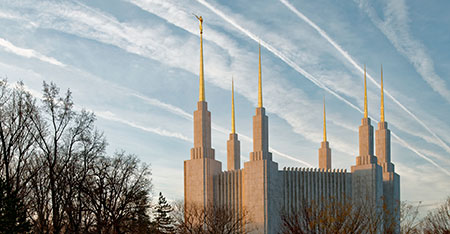
Washington D.C. Temple
The temple is important in your life, especially when you’re young: “The young man needs his place in the temple even more than his father and his grandfather, who are steadied by a life of experience; and the young girl just entering life, needs the spirit, influence and direction that come from participation in the temple ordinances.”1 Sure, if you say so. Can you explain why it's so much more important to the younger generations? I'm not getting it. If the temple ordinances are essential for everyone, how can they be more important for anyone? Begin now to prepare your heart and mind to be able to fully receive and understand these blessings. You already said this...

Receiving the Fulness of the Gospel  

"Fulness of the Gospel" refers to repentance and baptism (see 3 Ne. 11:40). The Book of Mormon is said to contain the "fulness of the Gospel" and it makes no reference to a dramatized temple play about Adam and Eve. The Book of Mormon also says the Bible contains the "fulness of the Gospel" and the Bible also lacks a description of our current LDS temple endowment. Let's be honest and stop pretending that Christ's gospel includes all the Mormon temple weirdness.

If you will prepare yourself to enter the temple, you will be “ready to receive the fulness of [His] gospel” in the temple (D&C 35:12; emphasis added). That verse says nothing about the temple endowment. The temple is a place of power and blessing. The pull quote from above! Let's see if you explain either the power or the blessings... The Lord instructed the Prophet Joseph Smith and the early Saints to gather to Kirtland, Ohio, USA, where they would eventually build a temple. Damn, looks like you preferred to skip the explanation. Oh well. On to the Kirtland temple... Are you insinuating that it was used the same way as today's temples? I hope not. It was more like a stake center and storehouse, and you probably know that. “There you shall be endowed with power from on high” (D&C 38:32; emphasis added). This revelation was given in 1831. When was the endowment introduced? Over a decade later shortly after Joseph Smith had become a Freemason. It's safe to say that the endowment of power mentioned in D&C 38 has nothing to do with the Freemasonry ceremonies the LDS Church later co-opted.

At a recent temple open house, an Apostle gathered his family around the holy altar in a sealing room. He taught them that everything we do in the Church—classes, activities, programs, and meetings—prepares us to come to the temple altar to receive the sealing ordinance. That's so true. Unfortunately for Mormons Jesus never taught it. The temple represents the very essence of your Heavenly Father’s plan for your eternal happiness and progression. If only that plan made any sense.

Preparing to Make Covenants with God

Your preparation to enter the temple and make covenants doesn’t happen quickly. The minimum requirement for an adult convert is a year. That's not very long. It began with your baptism and the confirming gift of the Holy Ghost and then grows with prayer, scripture study, obedience, and service. Actually faith and baptism is really all Jesus ever asked for. If someone does everything you've listed, Jesus would be thrilled. It invites cleanliness weekly as you participate in the sacrament. Partaking of the Lord's supper was about participating in the community of Christians (the body of Christ), not about preparing to dawn a bunch of robes and pretend you're Adam or Eve. It happens as you learn to seek forgiveness through repentance, as you keep standards, and as you worthily carry a limited-use temple recommend. Yes, keeping your Jr. membership card certainly keeps your eye focused on becoming a gold member card carrier. Youth programs will help you, but your preparation is personal; you are developing your worthiness, your testimony, your conversion. How can teens have a testimony of something they've never heard about in their lives? Tell them, please, what happens in the temple! The Savior’s Atonement applies to you personally. Non sequitur.

As you increase your level of spiritual maturity, you will desire to prepare for and enter the temple. Don't confuse maturity for increased gullibility, deeper financial investment and fear of non-conformity, sir. There you will receive ordinances and make covenants, which are necessary steps to draw closer to your Heavenly Father. Which ordinances? Which covenants? Can't you spell them out? Why don't the New Testament and Book of Mormon mention anything besides baptism? Temple ordinances are “the most exalted … ordinances that have been revealed to mankind.”2 You mean revealed to the Freemasons in the late Middle Ages and stolen by Joseph Smith in the 1840s.

As you receive temple ordinances, you make solemn covenants with your Father only one time for yourself, and then you will strive to abide by them throughout your life. Holy cow, you actually kind of said something informative!! Kids, according to Mormon doctrine, you only have to go through once! Each time you enter the temple, you can feel of His Spirit and receive additional revelation and understanding while providing the necessary ordinances for others. What if we don't feel the spirit at all, let alone receive revelation? As for "others", why are we doing the work for people who's names have already gone through the temple many times before? You will understand and receive assurance of your eternal existence and the unending power of your covenants. I didn't. The temple made me feel very unsure of everything and made covenants feel cheap. If we were not eternal beings, the temple would have no significance. You don't know we are eternal. No one does. You may hope and believe we are, but you don't know. If you or anyone else wishes to disagree, please present your evidence. You enter the temple and make covenants because you will exist eternally and want to be with your Heavenly Father and your family in “never-ending happiness” (Mosiah 2:41). Heavenly Father is such a loving dad, right? This assurance grows in your own soul and is confirmed by the Holy Ghost. Unless it doesn't and isn't. What do you have to say to people who made every effort to experience this and didn't?
young woman

Being Worthy

The role of the Holy Ghost is real. He teaches you, purifies you, and conveys the Father’s love (see Romans 5:5). Does he?The Holy Spirit of Promise is the ratifying power of the Holy Ghost, which validates each covenant eternally. How bureaucratic.

In order to receive the Spirit, you must enter the temple clean and pure, free from any unforgiven transgression. Or else what? Your endowment doesn't count? Name one case of an unworthy person's presence being detected. Please explain what happens to the children and grandchildren of a someone who was unworthy at his or her sealing. Do you have answers to these kinds of questions or are you just trying to scare kids into conformity? If the adversary could succeed in any way to overcome you, it would be to keep you from the temple or to entice you to go there unworthily. Satan's very scary like that. What would happen should he succeed? Does the temple cave in on you? Let's lower the stakes now. What happens to the sacrament, for example, when it's blessed by teenage hands that have masturbated only hours before?

For this reason, you will be invited to sit in a personal interview with your bishop or branch president, to consider your worthiness and readiness to receive a recommend to enter the temple. These interviews are the worst, even for kids who have nothing to confess. Not only that, they shouldn't be allowed. Parents, do not let your teens be interviewed alone behind closed doors! Be honest and trust him to help you. Why trust him? He has no professional training. How do we know he's not jerking off like the rest of us? In reality, you are determining your own standing before the Lord (see D&C 109:24). Are you sure you cited the right verse? Yes, it used the word "standing" but that doesn't mean it backs up your point, which wasn't a bad one, by the way. I think it makes a lot of sense to cut out the middle man and take things into your own hands. You will sign your own recommend first. You are witnessing your worthiness before the Lord. 3 No, it's to the bishop and the temple ushers. They say God can see your whole heart and mind, so he wouldn't need to watch you sign your name, would he?

To be worthy does not mean you are perfect yet. It means that your heart is right, that you are living the commandments, and that you desire to be better each day. So if we feel our heart is in the right place (I felt that way), we're living the commandments (I was), and we desire to improve day to day (I certainly did) we can skip the interview? Of course not. God still needs to watch us sign our name for some reason.

Learning from Symbols

In the temple, as in the scriptures, the Lord teaches using symbols. You can find many symbols in the scriptures, such as the rock, the seed, the fruit, the tree of life, and the bread and water of the sacrament (see, for example, 1 Nephi 11; Alma 32; Helaman 5:12). Baptism by immersion symbolizes new life, rebirth, and cleanliness (see Romans 6:3–5). In the temple we all wear white, symbolizing purity, holiness, light, and equality. Wow! You just taught an actual symbol from the temple! Oh wait, that whole white=purity/holiness thing is from baptism (and baby blessings). Nothing new here.

Some symbols in the temple are both physical and spiritual. For example, wearing the garment is a physical daily reminder of the temple covenants and the promised blessings. If respected and honored, the garment protects us from temptations and unrighteous influences. Does it? So it's like a magic Satan shield? Say we're about to steal something, for example, will we suddenly think of our uncomfortable underwear and remember what it means? Never mind, I have a more important question: How is this different from the Gift of the Holy Ghost that we get at confirmation? Isn't he supposed to be prompting us and keeping us from evil all the time? So why in the world do we need garments or an awful script if they're doing the exact same thing?

Each of the temple ordinances is symbolic. And also literal, though. I was physically anointed with oil, brother. A man said the words and touched my naked body. That's literal. I also literally wore some ridiculous clothes on top of my ridiculous garments and was taught about the true robes of the Priesthood and the false Priesthood robes of Satan. It's not just symbolism. “In a sacred ceremony, an individual may be washed and anointed,”4 reminiscent of the kings and priests of ancient Israel being prepared to take their positions (see 1 Samuel 10:1; 16:13). Yeah, but we're also literally being anointed to become kings and priests, queens and priestesses to the most high. That's literal, not symbolic. That's why these ordinances are essential, right? The instruction and covenants in the endowment signify being clothed or invested with additional power and promises from God (see Luke 24:49). Please take a few paragraphs to lay out what we covenant in the temple. Also, this verse has nothing to do with the LDS temple, don't pretend it does. It's dishonest. Perhaps the most beautiful symbol is the sealing ordinance, in which a couple is united in an unbreakable bond which can last through all eternity. So is there a real "unbreakable bond" or is it just symbolic? Most Mormons tend to think they really truly are literally going to be with their families forever when they get sealed.

The promises in the temple are rich and noble. What are they? You still haven't told us. They are the “great favors” and “great blessings” (3 Nephi 10:18) that our Father has reserved for you personally. So I read the verse and it seems like you're implying that we'll personally see Jesus if we go to the temple. Is that what you're saying. You're being extremely vague yet tantalizingly suggestive. So smile when you think of the temple. Smile because we love mystery?

No matter your age, do whatever is necessary to be ready to receive the greatest blessings your Father in Heaven offers to you. And you think that those blessings are found in the enactment of a 2-hour Freemason-inspired dress rehearsal for the Celestial Kingdom? That would be nutty. Oh yeah, how come you haven't mentioned Freemasonry yet?? Trust how it felt when you were a child and sang, “I love to see the temple. I’m going there someday. … I’ll prepare myself while I am young. This is my sacred duty.”5 I felt a lot of things while singing Primary songs. Usually I felt anxious to get home and eat. Later in life I felt uncomfortable hearing children sing those songs. They felt brainwashy, especially "I Love to See the Temple". It can be true for you. Kent, I'm sorry to say this, but you're a shitty salesman. :(

Why Do We Build Temples?

“We must gain some feeling for why we build temples, and why the ordinances are required of us. "Feeling", not understanding? Thereafter we are continually instructed and enlightened on matters of spiritual importance. Do we take classes or have deep discussions in the temple? No, no we do not. It comes line upon line, precept upon precept, until we gain a fullness of light and knowledge. You mean until we see Jesus in the flesh? No, you mean we sit in silence and go through the endowment a bunch of times until we think we have it all figured out. We make up all the addition lines and invent all of the new precepts for ourselves because no one sets us straight. We remain tight-lipped about it all (because it's sacred) and then we die. This becomes a great protection to us—to each of us personally. … What "fullness of light and knowledge" becomes a "great protection"? You haven't explained it, you just insist on it.

“… No work is more spiritually refining. Jesus would very much disagree with you. Try feeding the hungry, clothing the naked and caring for the sick. No work we do gives us more power. This means nothing to your reader because you haven't explained the "power" is or why we need more of it. No work requires a higher standard of righteousness. Not even parenthood? You can be a parent without being endowed.

“Our labors in the temple cover us with a shield and a protection. … More empty words. Please explain yourself.

“… If we will enter into our covenants without reservation or apology, the Lord will protect us. Considering the fact that we almost all enter the temple without any real knowledge of what we'll be doing there, I think it's safe to say that essentially everyone enters without reservation or apology. So what is the Lord protecting us from? We will receive inspiration sufficient for the challenges of life. … This is not true. I received no inspiration that was worth a damn in the temple. None. Maybe I'm the exception...

“So come to the temple—come and claim your blessings.” What blessings? You keep making promises without saying what those promises are.
Preparing to Enter the Holy Temple (booklet, 2002), 37.

Key Points

  • In the temple you receive ordinances essential to your salvation. Only baptism is essential. Read your scriptures.
  • You must enter the temple clean and pure, free from any unforgiven transgression. Or else what?
  • As in the scriptures, many of the teachings and ordinances in the temple are symbolic, allowing you to learn more and more each time you return to the temple. What happens when you run out of symbols? Or when all the symbols mean the same thing? What about all the literal stuff? You didn't really discuss that. In fact, you didn't really discuss anything. This whole article was nothing more than smoke and mirrors. May God have mercy on your dishonest soul. 

Thursday, September 18, 2014

"Mindguards"

 
The last of Irving Janis' symptoms of groupthink is the existence of "self-appointed members who shield the group from dissenting information". In other words, people either hiding or spinning the information that's out there. 

The LDS Church has both self-appointed mindguards and officially appointed mindguards. On a very low level, consider all of the parents, bishops, and stake presidents who purposefully neglect they youth of a clear understanding of what goes on in the temple. On the opposite end of control, consider the documents hidden in the First Presidency vault. Why are are members kept from these things (and everything in between)? 

In the semi-self-appointed category we have the apologists produced and employed by BYU. In a way they're endorsed by the Church. They're paid by the Church and their work has been crucial for the writing of the recent "difficult issues" topics on the Church website. And yet the Church can turn its back on these people and their work whenever convenient. 

On the side of officially appointed mindguards we have the Church historians and the Public Relations department. 


How can the general membership be expected to have its own thoughts and opinions about Church history, doctrine, and policy when certain information is kept from them?

Wednesday, August 20, 2014

Smooth operator


Folks living in the Middle East and the Mediterranean are lucky sons of guns! They're blessed enough to live where olives have historically been cultivated and spread. Why does that matter? It matters because olive oil is the awesomest!


It's a magic healing elixir, folks. When consecrated by the power of the Holy Melchizedek Priesthood, it has amazing healing powers.


It transforms people into priests.


It turns you into royalty.


It made Jesus the Oily One way awesomer than all the other Jesuses. (I guess there were olives in the Pre-Existence.)


It guarantees Celestial glory.


And it's edible.


The point is this olive oil is very cool stuff when backed up by the proper magic which is why Mormon men tend to be locked and loaded at all times.


Keep your barrels well oil, brethren.

Monday, March 3, 2014

The temple - doubly secret secrets


Even as an endowed, sealed member of the LDS Church, there's a good chance you've not been informed on all the goings on of the temple. Growing up Mormon I remember hearing about meetings in the upper room of the Salt Lake temple that supposedly involved the Big JC sitting down at meetings, and I remember studying about Holy of Holies in the Israelite tabernacle and Solomon's temple. There was a lot of speculation with friends about what happens in the temple we went through, then there was more speculation about what also happens in the temple after we went through. Isn't it a little strange that we were still speculating even after we had received the secrets of the Kingdom? I had heard the James Talmage had written his magnus opus Jesus the Christ in the temple, but I couldn't imagine where. There must be private room I had never seen and had absolutely no idea how to access. I had also heard rumors about a special feet washing ceremony, or something awesome like that, for apostles, who were probably getting visitations from Jesus. The point is that even as an endowed member of the Church, the temple was still VERY MYSTERIOUS.

Fortunately a brave soul has come forth to share the insider of insiders information with all of us outsiders of insiders. Tom Phillips gave an interview to Mormon Stories' John Dehlin, but the potato was too hot and never made onto the Mormon Stories site. It's okay, though, because it's on various other sites in various forms. Here is one of two YouTube excerpts from the five-hour-long interview.


Part 2 is here. (Notice that Tom is still very careful about what he says and doesn't say.)


Tom and his wife were instructed to keep their experience on the down low. Call this sacred if you want - Tom speaks of it as a very touching and tearful experience - but it's also extremely secret. And disappointing. SPOILER ALERT: JC never showed.

On the plus side, Tom's "calling and election" were "made sure"! He had been given the most explicit guarantee of the Celestial Kingdom in all of Mormonism.


Think how many more converts the missionaries would have if they had this carrot to wave in front of investigators!

About the same, you say? You're probably right.

Sunday, October 27, 2013

The temple - washing and anointing


As is customary in the Church of Jesus Christ of Latter-day Saints, I took out my temple "endowment" a couple of weeks before going on a mission at nineteen years old. I had no idea what would happen. I knew I would be inducted into wearing Mormon garments somehow at some point and that was good enough for me. I had grown up seeing my parents garments regularly in the laundry but they were often washed separately from the rest of our underwear. I picked them up and looked at them from time to time for the sake of curiosity but never for too long (they were Mom and Dad's underwear after all and who really wants to handle their parents underwear?). Mom's were particularly mysterious because they were all silky and slippery and seemed generally shapeless and incomprehensible.

I had no problems believing in the legitimacy of garments. On my way to the temple I knew I would be instructed (or commanded) to wear garments all the time from that day forward and I was okay with that. I was even excited about it. Honored actually. Garments to me represented the passage to adulthood. I would finally get to dress like the adults and see and do what the adults in Mormonism do (except for having sex).

I had heard, however, that not everyone likes the temple, that some people stop going to the temple or even to church because it's so weird. Once I heard a cousin make some kind of joke about people running around naked. It was enough to make a fellow at least a little nervous. This was going to be the day that I learned why non-Mormons considered Mormonism a cult. But I knew I wasn't joining a cult. I knew the Church so well. I had an entire life of devout attendance under my belt and I was sure everything would turn out great and I'd treasure the experience for the rest of my life.

As it turns out once things got rolling I found myself a little annoyed that I had no idea what I was doing or what was coming next. Why was it so taboo to talk about the temple? Why hadn't I been given any kind of detailed rundown before the big event? We make little kids practice being baptized over and over in preparation for the big day, but no one gets any training whatsoever before going through the numerous ritualistic components of the temple.

So when I was instructed to take off all my clothes and put on the "shield" (read white poncho) I felt a little weird. "Oh, I guess you do get naked in front of people in the temple. Um... Okay, what the heck, I'm here and I'm committed (plus I've got a decent washboard going on), whatever, here it goes..." I started striping down and the two officiators (old white guys I'd never seen before in my life) freaked out a little bit and told me to put the shield on first and then get undressed underneath. "Oops! Thanks a ton for being so clear the first time, guys! Are you two new at this by any chance?"

I wasn't sure if they were embarrassed by my mistake, embarrassed by my naked body, annoyed they hadn't given me clearer instructions, or annoyed I didn't know the drill. Whatever the case may be, I definitely felt embarrassed and annoyed.

They indicated for me to sit down on a chair, which I did, and then one of the guys said an obviously scripted prayer, touched me with a wet (just water) finger, said another prayer of sorts about me becoming a kind and a priest to the most highest godliest gods, etc., and touched me again but this time with an olive oily finger.

When I say touched I mean his finger made contact with my skin. Mostly this was no biggy because it's not like he was giving me a holy handjob with oil, but then again it was pretty messed up. I was naked and this stranger was touching me in the name of the afterlife. And yes, he did reach just inside the poncho so he could touch my side. Twice. That's messed up. I didn't like it. 

The experience got a wheel or two turning. The first wheel spun in the direction of "this is not cool! why does God want me to do this?" and the other wheel ran the direction of "dude, we're so sensitive and PC these days! just think what this was like back in the ancientest of times!" I couldn't decide if this was an occasion worthy of calling the cops or a lesson in how I was too prideful and skeptical and needed to just let the Spirit work. Here's what I did: I blocked my doubts and went ahead with the rest of the experience. (I had a mission to go on for Christ's sake!) I was finally instructed to put my Gs on. They felt way too big but I was happy enough to have them. 

In 2005 the Church changed the washing and anointing so that inductees wear their garments under the shield so they're no longer totally naked under there and the administrators no longer physically touch the inductees. It's a nice enough change, I guess. It's still an incredibly uncomfortable ordeal to go through, I'm sure. The crazy thing is that back in the day people really were completely naked, without even a small poncho, during this ceremony. 


Considering the fact that Mormons have gone from totally naked in a bathtub where they were completely washed by someone else to sitting in their underwear and a poncho while someone only gestures to touch them, I think it's safe to say that the washing and anointing is one of the most changed rituals of Mormonism. And that's significant considering the fact that Mormon's make such a stink about baptism being altered from full emersion to just a couple of drops of water on the head.

I don't wear temple garments anymore because they're a crock of shit embroidered with Freemasonry symbols and I don't need lame Freemason symbolism on my underwear, however if I were to get some today, instead of paying my tithing and attending the temple and shopping at the Church Distribution Outlet, I'd just go to Mormon's Secret and buy some that fit.