Showing posts sorted by relevance for query Joseph Smith polygamy. Sort by date Show all posts

Monday, June 16, 2014

Helen Mar Kimball (Smith) Whitney - wife #27


Helen Kimball (August 22, 1828 - November 13, 1896) was the daughter of Heber Kimball, perhaps biggest horse's dick of all the early Mormon polygamists. Heber was so fucking classy he decided it was a great idea to hand fourteen-year-old Helen - his only daughter - over to Joseph Smith as a wife. Fourteen years old! Then again, Heber would have done anything to be eternally close to Joseph. Even Helen saw that her dad was obsessed enough with being sealed to Joseph Smith and saw herself as a spotless offering on her father's behalf. (Heber stayed obsessed by the desire to be sealed to Joseph to the day he died when on his death bed he asked his wife Sarah, who was sealed to Joseph, to intercede on his behalf.)

Helen was three when her parents joined the Church. They moved to Kirtland, where Heber was ordained an apostle, in 1835. They eventually moved to Nauvoo, where they settled near the temple lot.

Heber, not Joseph, was the one to approach Helen about polygamy. He gave her 24 hours to think things over. Helen was repulsed by the idea, as was her mother, Vilate Murray, who had seen how challenging plural marriage was for other women. But this was all about Heber's salvation. Helen agreed to do it and Vilate sorrowfully consented.

Helen was Joseph's fourth teen bride in a row in less than a month. So many virgins! Yay!

I'm not sure who the hell decides to marry his friend's fourteen year old. I actually doubt it was Joseph's idea; I think it was Heber's. I also think Joseph should have told Heber to cool his fucking jets and at least give it a few more years. I don't know if Joseph slept with a Helen, but I also can't see why he wouldn't. Either way, the marriage changed Helen's life significantly. She was no longer allowed to be a young girl and enjoy her previous social life. She absolutely hated polygamy.

No dancing for you, young Mrs.!

Almost two years after Joseph was killed at Carthage jail Helen married Horace Whitney (pictured above). Helen was still sealed (in fact, resealed at the time of her marriage to Horace) to Joseph, and Horace was sealed to Elizabeth Sykes, who was dead. They had eleven children: Helen, William, Horace, Vilate, Orson, Elizabeth, Genevieve, Helen (again), Charles, Florence, Phebe.

I wonder what their eternal family will look like. Will Helen and Joseph get the kids? Will Helen and Horace? Will Horace and Elizabeth? Will they all just share? Why don't these sealings resemble our sealings today?

Not surprisingly, Helen came around to polygamy. In her later years she became an advocate for it. She died in Salt Lake City.

Saturday, June 7, 2014

Elizabeth Davis Goldsmith Brackenbury Durfee (Smith) Lott - wife #12


Elizabeth Durfee (March 11, 1791 - December 16, 1876), Joseph Smith's twelfth wife, gives us yet another case of Joseph marrying a woman who "belonged" to another man. At the time of her marriage to Joseph she was still Jabez Durfee, her third husband following the death of her previous two.

The Durfee's moved to Nauvoo with their ten children (she had had children with both of her previous husbands and Jabez had a few of his own as well) in 1839. She married Joseph Smith in 1842. She was 51 and, like the Patty Sessions, who was also older than Joseph, became a polygamy recruiter. Elizabeth was not a virgin and did not bear Joseph any children. Emma didn't know about this marriage either.

Elizabeth and Jabez separated shortly after Joseph's death. She married again, this time to Cornelius Lott. In addition to finding a fifth husband, she got a sister wife through Cornelius' daughter Melissa, who was also married to Joseph.

Elizabeth never made it out to Utah. Instead she grew tired of the Brighamites and went back to Nauvoo, where she joined Emma and Joseph Smith III in the Reformed LDS Church (Community of Christ).

Marry the prophet! Marry the prophet! Don't disobey!

What, pray tell, is holy about Joseph Smith recruiting older women to help convince young women to marry him? How awful is it to have pressure from both the prophet and a few select older women of the community? Did Elizabeth know that Joseph was having sex with some of his wives or did she think this was all a spiritual thing?

Wednesday, June 4, 2014

Presendia Lanthrop Huntington Buell (Smith) Kimball - wife #6


Zina's older sister, Presendia Huntington (September 7, 1810 - February 1, 1892), also married Joseph Smith about two months later. Like Zina, Presendia was already married. She and her husband Norman, with whom she would have seven children, had been following Joseph Smith since joining the Church together in 1836.

Again, Joseph deserves a little credit for being upfront with Presendia about plural marriage (even if he was going behind Emma's back). To his discredit, it seems as though this marriage was likely part of a salvation bargain with Dimick Huntington, the brother of Zina and Presendia who officiated the marriage. That's right, Dimick gave off his sister in exchange for a place with Joseph and the Smith family in the Afterlife.

Dimick Baker Huntington, brother.

After the marriage Presendia continued to live with her first husband, Norman, until 1846 when he couldn't handle the Mormons anymore. She left him and one of her two surviving children, 16-year-old George, and took the other child, six-year-old Oliver, to go live as Heber C. Kimball's plural wife (his sixteenth at that point).

"I think no more of taking another wife than I do of buying a cow." (actual quote!)
Heber Chase Kimball, good man

Unaware that she had already married Heber, Norman tried to get back with Presendia only to be denied. Presendia and Heber had two children together: Presendia Celestia Kimball and Joseph Smith Kimball.

Presendia is yet another example of someone who according to the rules of polygamy should never have taken on a second husband. In the case of her marriage to Joseph Smith, she was not a virgin and the two never produced children; in the case of her marriage to Heber Kimball, she still wasn't a virgin and she was definitely sealed to another man.

But you don't need the rules to get a sense of how messed up the marriage game was in Nauvoo. If there is any righteousness in Presendia's story, you'll have to help me find it.

Sunday, June 1, 2014

Emma Hale Smith Bidamon - wife #1


The relationship between Joseph Smith and his first wife Emma Hale was a complicated one. They went through a lot together and must have shared an extremely tight bond. Their life together started with an elopement that sent Emma's father Isaac into a rage. They faced three infant deaths in their first years together. Emma gave birth to twins who died shortly after birth. She and Joseph then adopted a neighbor's twins, Joseph and Julia, whose mother had died in childbirth (Joseph died a year later). They eventually had four more sons - Joseph, Frederick, Alexander, and Don Carlos - who all survived infancy and childhood. Emma helped transcribe The Book of Mormon, she watched Joseph build and lead the church, she sat helplessly by as Joseph fled mobs and the law, and she deeply mourned his assassination.

I'm very sympathetic toward Emma and I think there is a lot about her to celebrate. She was extremely loyal and was full of conviction. She weathered hard times thanks to her strong frontier attitude of determination, the same determination the Church loves to credit the early pioneers with. I can understand why the Church and its members paint a picture of Emma as being tirelessly rosy and totally admirable. It's easy to see Emma as an unwavering pillar of the early Church. The thing is there's a lot more beneath the surface that make her a tough nut to crack. Here are a few points that come to mind.

Speaking of the day she eloped with Joseph she says that she had no intention of marrying him, but he was more of a catch than any of the other men she knew. It sounds to me like Joseph talked her into it, just as he would talk other women into marrying him later on. I have a hard time seeing their marriage as an equal partnership, instead it looks like Emma might have been just another victim of Joseph's suave tongue.


Another reason I see Emma as a potential victim comes from the fact that she was kept in the dark about his various liaisons with other women. Nowadays we call what Joseph did marital infidelity or cheating. Emma was cheated on again and again and yet she stuck by his side just as you would expect someone who is manipulated and emotionally abused to do.


When Emma refused to accept Joseph's secret polygamy, Joseph came back with a supposed revelation from God warning her that she would be destroyed if she didn't change her mind. That's some fucked up shit right there, friends. I take my hat off to her for calling bullshit on that revelation and throwing it in the fire.


And here's a hell of an issue: Emma defied Brigham Young as the new prophet, stayed in Nauvoo, and got her son Joseph to start the Reformed Church of Jesus Christ of Latter-day Saints (today called the Community of Christ). Why would such a righteous, spiritual woman make such a damning move? Why didn't the Spirit direct her under Brigham's wing and into The One True Church? Should the Church today celebrate her as it does, or should it go back to maligning her character and excluding her from Church history?

Emma married Lewis Bidamon in 1849 and stayed with him until her death. She never again acknowledged that Joseph had practiced polygamy and that she herself had been dragged temporarily into the practice.

Thursday, November 13, 2014

Polygamy - Joanna's take


Here are a few things to consider from Joanna Brooks' recent blog post.

"[T]he new website on Joseph Smith’s polygamy does not say that Smith was wrong—not for marrying against the wishes of his first wife Emma, or marrying women already married to other men, or marrying girls as young as fourteen. It acknowledges that Smith’s polygamy demanded heartwrenching sacrifices of his first wife, but it sidesteps the crucial question of whether these sacrifices were founded in lasting principles of Mormon theology, or were they pains caused by the human excesses of our charismatic founder?

Is it the will of God that polygamy should persist in LDS Church theology and policies pertaining to LDS temple marriages, as it does to this day?"

Dear Tommy, would you and your buddies please let us know if LDS Mormons today are rightly dreading future (and eternal) polygamy?

Wednesday, June 4, 2014

Zina Diantha Huntington Jacobs (Smith) Young - wife #5

The early 1840s in Nauvoo is where and when Joseph Smith's polygamy took off. We can only guess as to why. Maybe it was because Joseph was under threat of death by an angel of God if he refused. Or maybe it had something to do with the fact that now Joseph had an entire city full of citizens eager to show their faith and devotion in his prophetic calling and willing to do just about anything to gain God's favor. Whatever the case, Joseph's marriage to Louisa really set things in motion. Zina Jacobs followed in relatively short order.


Like Louisa, Zina had recently lost her mother to the early Nauvoo malaria epidemic. In addition to coping with her mother's death, Zina had to juggle the attention of two suitors: Henry Bailey Jacobs, who wanted a wife, and the nearly all-powerful brother Joseph, who explained (to his credit) he needed another wife. Henry had started his pursuit before Joseph, but that didn't necessarily rule out Nauvoo's number one citizen. Amazingly she turned Joseph down to accept Henry's proposal.

Or maybe Zina's refusal shouldn't shock us at all. How many women are dying to become a sister wife?

A couple of months later Joseph came back at Zina with this story:


Obviously the death-threatening angel bullshit worked. Despite the deep shame she felt by consenting, Zina eventually (and conveniently) gained a testimony of plural marriage.

Zina continued living with Henry, but Joseph kept sending Henry on missions. After Joseph was killed, Zina married Brigham Young, who sent Henry to England. Zina then moved in with Brigham and his other wives leaving Henry feeling like total shit. Poor Zina. Poor Henry.

Why was Zina ever a candidate for plural marriage? She was not a virgin and she did not bear children with Joseph. And do you honestly think Emma gave her consent?

Here is the Feminist Mormon Housewives Podcast episode about her. 

Monday, June 9, 2014

Eliza Roxcy Snow (Smith) Young - wife #15

 
Eliza Snow (January 21, 1804 - December 5, 1887) was one messed up lady. She was known as a poet from her early years so maybe we should say she was more of a trouble artist type. Some say she lived a life of celibacy, some say she was raped by persecutors of the Church, some say she had sex with both her husbands, some say she was pregnant at one point with Joseph Smith's child. However mysterious her sex life may be, her poetry and autobiographic writings reveal someone who needed some serious help. To put it mildly, she was dramatic as fuck and completely full of herself. I'm amazed anyone wanted to be around her.

Eliza seems to have had a taste for Primitive Church movements. She first joined Alexander Campbell's Christian primitivist movement and then the Mormons. She moved to Kirtland, where she stayed with Joseph and Emma, even after being given her own lot. She moved with the saints to Missouri and then Nauvoo, where Joseph gave her an appointment in the newly organized Relief Society and told her about plural marriage. She was disgusted by the idea for all of a couple of months, and then she married Joseph.

Joseph eventually invited Eliza to live with him and Emma in Nauvoo for what Eliza hoped would be a permanent stay. She took up teaching the Smith children.

Living conditions soon got out of hand. About six months in Emma found out that Eliza was a sister wife, freaked out (Eliza says she kept her cool), and sent her down a flight of stairs (some say with a broom, other say by her hair). Eliza's fall might have prematurely ended a pregnancy, either way, it ended her stay with the Smiths.

It still hurts like like before, doesn't it Emma? 
Maybe worse because Joe didn't learn the first time?
Maybe worse now that it's a self-righteous bitch your own age?

Eliza was a staunch and dishonest defender of polygamy. The same year she married Joseph she sent around a petition in Nauvoo collecting signatures from a thousand women denying Joseph's involvement in polygamy. Later that year she produced a Relief Society document denouncing the practice. 


When Joseph died Eliza stayed close to power; she married Brigham Young (yet another reason why Emma would have no interest in moving out to Utah). Eliza never had any children of her own but she raised or help raise many by other women. She fought for women's suffrage and refused to be powerless. Today she is one of the most celebrated women in the LDS Church.

Sunday, June 15, 2014

Sarah Lawrence (Smith) Kimball Mount - wife #25


Sarah Lawrence (May 13, 1826 - ca. 1890) and her sister Maria (December 18, 1823) were left orphans at the respective ages of 16 and 19 after moving with their parents from Canada to Nauvoo. Joseph Smith became their legal guardian and the sisters lived with the Smiths alongside Emily and Eliza Partridge. Like the Partridge sisters, Sarah and Maria were drawn into polygamy with Joseph Smith with Emma's consent. They continued living with the Smiths until Joseph's assassination.

Sarah was married to Heber Kimball, had four children, but divorced him less than a decade later. She later married Joseph Mount and started denying any connection to Joseph Smith and Heber Kimball. Her life ended in California.

Wednesday, August 12, 2015

LDS FAQ - "Masonry and the Temple"

I found a brief Church-sanctioned (I believe) explanation of the LDS temple's relationship to Freemasonry. I'm curious what it says. Text found here.


Students of both Mormonism and Freemasonry have pondered possible relationships between Masonic rites and the LDS temple ceremony. Although some argue that Joseph Smith borrowed elements of Freemasonry in developing the temple ceremony, the Endowment is more congruous with LDS scriptures (especially the book of Abraham and the Book of Moses) and ancient ritual than with Freemasonry. Both the book of Abraham and the Book of Moses are texts Joseph made up out of thin air, so I personally don't see why anyone would feel better knowing that they've influenced the creation of the LDS temple ceremonies. Pointing out that the temple has more more in common with those writings than with Freemasonry still doesn't justify the presence of Masonic oaths and handshakes in the temple. Latter-day Saints view the ordinances as a revealed restoration of ancient temple ceremony and only incidentally related to Freemasonry. There's no good reason to think the LDS temple ceremonies are ancient and I'm looking forward to seeing how you continue to downplay the influence of Freemasonry. The two are not antithetical, however, nor do they threaten each other, and neither institution discourages research regarding the ancient origins of their two ceremonies. The origins of Freemasonry are not ancient at all, they are medieval, late medieval. Many sacred ceremonies existed in the ancient world. Modified over centuries, these rituals existed in some form among ancient Egyptians, Coptic Christians, Israelites, and Masons, and in the Catholic and Protestant liturgies. Is this written for 6th graders? I can't believe you dared list the Masons in this group. And Egyptians? WTF? Which Egyptians are you talking about? Common elements include the wearing of special clothing, ritualistic speech, the dramatization of archetypal themes, instruction, and the use of symbolic gestures. Levi Strauss would be so proud to read this, but aren't these elements too broad to be taken seriously in this particular discussion of Freemasonry in the LDS temple? One theme common to many—found in the Egyptian Book of the Dead, the Egyptian pyramid texts, and Coptic prayer circles, for example—is man's journey through life and his quest, following death, to successfully pass the sentinels guarding the entrance to eternal bliss with the gods. Right, Thor and all his buddies in Valhalla. Though these ceremonies vary greatly, significant common points raise the possibility of a common remote source. Human psychology most likely. Mormon wishful thinking knows no ends.


The Egyptian pyramid texts, for example, feature six main themes: (1) emphasis on a primordial written document behind the rites; (2) purification (including anointing, lustration, and clothing); (3) the Creation (resurrection and awakening texts); (4) the garden (including tree and ritual meal motifs); (5) travel (protection, a ferryman, and Osirian texts); and (6) ascension (including victory, coronation, admission to heavenly company, and Horus texts). Oh my god, that's so... DIFFERENT from the Mormon temple! Wow. Like such ancient ceremonies, the LDS temple Endowment presents aspects of these themes in figurative terms. Only if you're working in the most sympathetic of generalizations. It, too, presents, not a picture of immediate reality, but a model setting forth the pattern of human life on earth and the divine plan of which it is part. We're going to need some actual details here. It sounds like you're seeing what you want to see. It's called confirmation bias.
 

Masonic ceremonies are also allegorical, depicting life's states—youth, manhood, and old age—each with its associated burdens and challenges, followed by death and hoped-for immortality. The difference between your argument for the temple paralleling an Egyptian Book of Breathings and the Freemason ceremonies is that Joseph actually knew Masons and became one himself. On the other hand, he had no understanding of Egyptian despite having purchased a scroll containing a book of breathings. He feigned a translation that is laughable to today's Egyptologists. There is no universal agreement concerning when Freemasonry began. Maybe not, but no one can seriously claim it pre-dates the late Middle Ages. Some historians trace the order's origin to Solomon, Enoch, or even Adam. Only Mormon historians. Others argue that while some Masonic symbolism may be ancient, as an institution it began in the Middle Ages or later. Only everyone who isn't Mormon thinks this.
 

Though in this dispensation the LDS Endowment dates from Kirtland and Nauvoo, Latter-day Saints believe that temple ordinances are as old as man and that the essentials of the gospel of Jesus Christ, including its necessary ritual and teachings, were first revealed to Adam. Mormons have no basis for believing this other than the fact that Joseph Smith, a notorious conman, taught it to his followers and it has been believed and repeated for generations. These saving principles and ordinances were subsequently revealed to Seth; Noah; Melchizedek; Abraham, and each prophet to whom the priesthood was given, including Peter. There is no historical evidence to convince us most of these men ever existed (Peter is the exception) and much less evidence that they ever practiced the ceremonies of the current LDS temples. Latter-day Saints believe that the ordinances performed in LDS temples today replicate rituals that were part of God's teachings from the beginning. But they have no reason to believe anything similar. Hopefully the author of this article will cite some convincing texts.


The Prophet Joseph Smith suggested that the Endowment and Freemasonry in part emanated from the same ancient spring. Joe Smith? He's not a very trustworthy source. Do you know he tried to trick investors into funding an illegal bank? The man was as phony as a $3 bill. Thus, some Nauvoo Masons thought of the Endowment as a restoration of a ritual only imperfectly preserved in Freemasonry and viewed Joseph Smith as a master of the underlying principles and allegorical symbolism (Heber C. Kimball to Parley P. Pratt, June 17, 1842, Church Archives). I'm sure those few unnamed Freemasons were totally right... The philosophy and major tenets of Freemasonry are not fundamentally incompatible with the teaching, theology, and doctrines of the Latter-day Saints. Obviously not, but that does not mean they derive from ancient biblical patriarchs or that one group did not co-opt them from the other. Both emphasize morality, sacrifice, consecration, and service, and both condemn selfishness, sin, and greed. So what? You're talking about two groups who's morality is founded in Christian European thought. You're also ignoring the fact that essentially every ethnography you'll read will describe cultures who's beliefs include similar concepts and virtues. That says more about human psychology than it does about the LDS temple being ancient. Furthermore, the aim of Masonic ritual is to instruct-to make truth available so that man can follow it.
 

Resemblances between the two rituals are limited to a small proportion of actions and words; indeed, some find that the LDS Endowment has more similarities with the Pyramid texts and the Coptic documents than with Freemasonry. At this point, dear reader you should compare and contrast the text shared between the temple endowment and the Mason ceremonies. They are in many cases identical! Even if we are to accept the author's claim that they only make up a "limited" portion of the temple, that DOES NOT justify their presence in temple liturgy. I would love to see where the endowment plagiarizes Coptic liturgy in the way. Even where the two rituals share symbolism, the fabric of meanings is different. Because Joseph took the symbols and recast them for his own purposes. In addition to creation and life themes, one similarity is that both call for the participants to make covenants. You keep dancing around the details. I find this approach willfully dishonest. Yet, the Endowment alone ties covenants to eternal blessings and to Jesus Christ. How did you reach this conclusion? Your argument is "OK, we have similarities, but ours is legit, theirs isn't, trust me!"? I'm not impressed. The Masonic ceremony does not emphasize priesthood or the need to be commissioned by God to represent him. So whoever emphasizes that the most wins? What kind of moronic game are you playing? The active participation of God in the world and in men's lives is a distinctly LDS temple motif. As is God's active participation with women, but only through men. It's called divine sexism. While Masons believe in an undefined, impersonal God, everything in the LDS Endowment emanates from, or is directed to, God who is a personage and man's eternal Father. That doesn't mean Joseph Smith didn't steal the Masonic rituals and infuse them into his own thought. The Endowment looks to the eternities and to eternal lives, but Freemasonry is earthbound, pervaded by human legend and hope for something better. Because Joseph had to outdo everyone, including himself.


Freemasonry is a fraternal society, and in its ritual all promises, oaths, and agreements are made between members. In the temple Endowment all covenants are between the individual and God. You finally seem to be admitting they use the same oaths (which they do), even if directed to different entities. In Freemasonry, testing, grading, penalizing, or sentencing accords with the rules of the fraternity or membership votes. In the Endowment, God alone is the judge. You lost me. Do you mean that the Freemasons actually take quality control seriously while Mormons just let anything go in the temple? That's dishonest. In the Mormon temple you have someone checking on you every step of the way making sure you do everything just right. The difference being that Freemasons have to learn everything by heart and then get tested, whereas Mormons get to copy what's shown to them on the spot. Within Freemasonry, rank and promotions are of great importance, while in the LDS temple rites there are no distinctions: all participants stand equal before God. Not really. Men and women have separate seating and gendered clothing, including a veil to cover the faces of women. Husbands are placed over wives in the temple. Men get to become king and priests and women queens and priestesses. Historically kings ruled over their queens and we have no idea what a priestess even does according to Mormon doctrine. This is not equality. The clash between good and evil, including Satan's role, is essential to, and vividly depicted in, the Endowment, but is largely absent from Masonic rites. So Joseph added a maniacal Satan to the stage, so what? This is a red herring. You need to look at the details you so diligently avoid! That's where you'll find the real devil. Temple ceremonies emphasize salvation for the dead through vicarious ordinance work, such as baptism for the dead; nothing in Masonic ritual allows for proxies acting on behalf of the dead. Because it's a ridiculous notion. Why would a fraternity need to induct the deceased? Women participate in all aspects of LDS temple rites; though Freemasonry has women's auxiliaries, Masonic ritual excludes them. Freemasonry is a men's club, just like the LDS endowment was back when it was introduced. Both have changed (Mormonism first, thanks to polygamy) to be more inclusive of women. The Endowment's inclusion of females underscores perhaps the most fundamental difference between the two rites: LDS temple rites unite husbands and wives, and their children, in eternal families (see Eternal Lives; Marriage). Now you've moved away from the endowment, where the Masonic plagiarism is found, to the sealing room. You've just moved the goal posts, moron. Latter-day Saint sealings would be completely out of place in the context of Masonic ceremonies. Incredible. I almost want to give you points for trying, except I feel like you're purposefully being sloppy in your analysis of Freemasonry and the LDS temple. I don't know if you're being dishonest or if you simply don't know what you're doing.
 

Freemasonry's 5 points of contact as used in the LDS temple endowment until 1990.

Thus, Latter-day Saints see their temple ordinances as fundamentally different from Masonic and other rituals and think of similarities as remnants from an ancient original. This conclusion is only reached by ignoring the verbatim theft of oaths, the co-opting of symbols, the exact copying of handshakes, and many other elements, while simultaneously cherry picking cultures to compare your beliefs to and then staying back in the vaguest of generalities in order to avoid seeing your comparison implode.

KENNETH W. GODFREY should be ashamed of himself.

Sunday, June 15, 2014

Maria Lawrence (Smith) Young Babbitt - wife #26


Maria Lawrence (December 18, 1823 - ca. 1846) and her sister Sarah were left orphans at the respective ages of 16 and 19 after moving with their parents from Canada to Nauvoo. Joseph Smith became their legal guardian and the sisters lived with the Smiths alongside Emily and Eliza Partridge. Like the Partridge sisters, Sarah and Maria were drawn into polygamy with Joseph Smith with Emma's consent. They continued living with the Smiths until Joseph's assassination, caused in part by William Law's accusation that Maria was one of Joseph's secret wives.

Joseph, of course, publicly denied practicing polygamy.

Maria and Sarah tried unsuccessfully to get their parents property back from the Smiths.

Her next husband was Brigham Young, but that relationship was short lived and followed by a marriage to one Col. Babbitt. Maria died young at 22.

Monday, June 2, 2014

Frances (Fanny) W. Alger (Smith?) Custer - wife #2


In 1833, at the age of sixteen, Fanny Alger found herself living with Joseph and Emma as a sort of adopted daughter. Both Joseph and Emma were extremely fond of her, but Joseph loved her as more than a daughter.


Oliver Cowdery and Emma eventually discovered that Joseph's affection for Fanny had become physical and both made their complaints. Emma kicked Fanny out and Oliver accused Joseph of having an affair. Joseph never denied the sexual nature of his relationship with Fanny and insisted that Oliver acknowledge that he (Joseph) refused to call it an affair.

The first time hurts the worst, Emma. You'll get used to it.

Despite no extant evidence, apologists tend to frame the Fanny-Joseph tryst as marriage - A MARRIAGE WITH NO KNOWN OFFICIATOR AND NO WITNESSES. Sounds legit, right? Maybe Jesus himself officiated, or King David, or maybe Solomon (biblical dudes were always visiting Joseph when he needed them.) And yet Emma wasn't so convinced it was a marriage. I wonder why? The LDS Church didn't feel like including Fanny in Joseph's family tree either.

Isn't it a bit strange that Joseph was (kind of) living polygamy in 1833 when no revelation of restoration had been introduced and wouldn't be for several more years? The sealing power wouldn't even be restored until April 1836. Joseph was way ahead of the curve on this one! A better explanation for this whole mess is that Fanny was a tool of Satan sent to tempt Joseph and destroy God's budding church, but, as will always be the case, Satan's plan failed!

Five years later Fanny married Solomon Custer, with whom she had nine children. Unlike her parents, who eventually ended up in Utah, she eventually left Mormonism and joined her local Universalist congregation.

Members of the LDS Church generally know nothing about Fanny and if they do they tend not to bring her up. We're still waiting for the Church to address Joseph's polygamy in their recent series of essays on difficult historical matters.

Here's the Feminist Mormon Housewives podcast episode about her.

Saturday, December 12, 2015

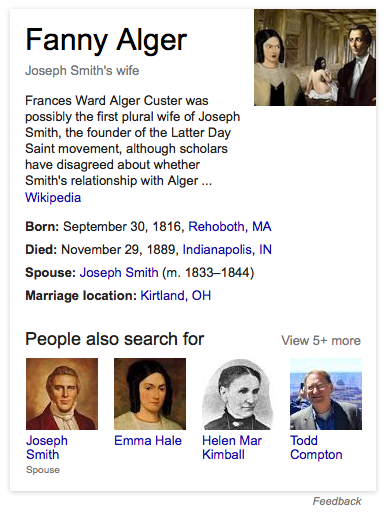
Google "Joseph Smith's wives" or "Fanny Alger"

If you search for "Joseph Smith's wives" in Google, please take the time to scroll to the end of the names and pictures at the top. It looks something like this:


It would appear that Fanny's picture comes from my blog post about her. I got it from this AMAZING VIDEO. Amazing as it is, it's not entirely accurate. No angel with a drawn sword was needed to convince Joseph Smith to practice polygamy until the early 1840s, several years after he had hooked up with Fanny and a few others. That's right, it doesn't make sense and it's not the only thing about the sword story that doesn't make sense.

The doubters seem well pleased. Emma looks pissed.


I'm just happy to have helped make a slight difference in the world.

Monday, June 16, 2014

Elvira Annie Cowles Holmes (Smith) - wife #29


Elvira Holmes (November 23, 1813 - March 10, 1871) joined the Church in 1835 at the age of 22. Her father Austin Cowles had joined earlier.

Austin moved his family to Nauvoo in 1840 where Elvira gained employment at the Smith residence.

It was there she met Joseph Smith's long time friend Jonathan Holmes, to whom she was married (by Joseph) and with whom she bore two children. Six months after her marriage to Jonathan, Elvira was sealed to Joseph. Jonathan deeply resented that his children with Elvira would be given to Joseph in the Celestial Kingdom.

Elvira's father Austin disaffected from the Church and helped with the Nauvoo Expositor, the paper denouncing Joseph's secret polygamy and contributing to the local anger felt towards Joseph.

Elvira moved out west with the saints. Her husband Jonathan married his second wife, Sarah Ingersoll Harvey Lloyd, in 1862.

Elvira died in Farmington, Utah.

Sunday, June 29, 2014

Filling pockets full of virgins


Isn't it at least a little strange that following Joseph Smith's death many of his wives were divvied up between Brigham Young and Heber Kimball? It's a fact that many of those women didn't meet the requirements for plural marriage in the first place and should not have been married to Joseph, but why would they end up automatically marrying other early Mormon bigwigs? Is there another rule about wives trickling down the chain of hierarchy upon a prophet's death?

What about Brigham and Heber's other wives? I'm sure if we were to look at the lives of each of these sister wives and the situations surrounding their polygamous marriage, as has been done with Joseph's wives, we would find plenty of instances to doubt the divinity and righteous practice of the Law of Plural Marriage. Maybe some day I'll get around to it, but then where would I then stop? How many early Church leaders practiced polygamy? How many women had to cope with the practice despite their better judgement?

Years ago we heard that polygamy helped house and provide for widows. Taking care of the surplus of women is a good thing. We heard that polygamy was needed to boost the Mormon population even though polygamy doesn't actually do that. We were told that only a very small percentage of Mormon men practiced it as if that would somehow make how it was practiced ethical. We even heard our prophet say he did not think polygamy was doctrinal even though the commandment and explanation of it is still contained our scripture.


There's a lot of history here that we could discuss - a lot - and the LDS Church is trying to discuss it as little as possible while still appearing open and willing. What I would like to see is more focus on the people who felt constrained to practice and not on the institutional justifications.

Wednesday, November 5, 2014

Polygamy - unscrupulous seduction


The recent explanation of how the LDS Church got involved in polygamy mentions that:

A few men unscrupulously used these rumors [of Joseph Smith marrying multiple women] to seduce women to join them in an unauthorized practice sometimes referred to as “spiritual wifery.” When this was discovered, the men were cut off from the Church.

Couldn't this also apply to Joseph? His version might look something like this:

Joseph Smith unscrupulously used his prophetic authority and a story about being threatened by an angel to seduce women to join him in an unauthorized practice sometimes called "celestial marriage." When this was discovered, he was cut down by critics and eventually a violent mob.

History is written by the winners.

Sunday, July 19, 2015

Temple prep - "Sacred Covenants"

The following text is taken from the pamphlet "Preparing to Enter the Holy Temple" (2002) and annotated by me.


The Lord in the revelation now known as section 132 of the Doctrine and Covenants announces:
For behold, I reveal unto you a new and an everlasting covenant; and if ye abide not that covenant, then are ye damned; for no one can reject this covenant and be permitted to enter into my glory.
For all who will have a blessing at my hands shall abide the law which was appointed for that blessing, and the conditions thereof, as were instituted from before the foundation of the world. (D&C 132:4–5.) This is the section Joseph "received" justifying polygamy. The new and everlasting covenant is unequivocally plural marriage. This is also the section that threatens Emma with death if she doesn't let Joseph marry the women he's already married and marry even more that he hasn't yet married.

President Joseph Fielding Smith defines the new and everlasting covenant in these words:
What is the new and everlasting covenant? I just told everyone, sorry. I regret to say that there are some members of the Church who are misled and misinformed in regard to what the new and everlasting covenant really is. Totally! Many believe it's eternal marriage. The new and everlasting covenant is the sum total of all gospel covenants and obligations. Huh? You know you didn't really say what it is, right? For those of you who missed it above, the new and everlasting covenant is heaven sanctioned polygyny. (Joseph Fielding Smith, Doctrines of Salvation, 3 vols. [Salt Lake City: Bookcraft, 1954–56], 1:156; hereafter cited as Doctrines of Salvation.)
This covenant includes all ordinances of the gospel—the highest of which are performed in the temple. To quote President Smith again:
Now there is a clear-cut definition in detail of the new and everlasting covenant. Let's hear the clear-cut version now... It is everything—the fulness of the gospel. That's not very clear. You've just muddled everything into one. It's almost as if you haven't read Section 132. So marriage properly performed, baptism, ordination to the priesthood, everything else—every contract, every obligation, every performance that pertains to the gospel of Jesus Christ, which is sealed by the Holy Spirit of promise according to his law here given, is a part of the new and everlasting covenant. Once again, that is not the definition the Lord gave in Section 132. I think you're probably trying really hard to downplay the importance of polygamy to early Mormonism. (Doctrines of Salvation, 1:158.)
In the verse quoted previously (Doctrine and Covenants 132:4) the Lord spoke with unmistakable plainness: “… for no one can reject this covenant and be permitted to enter into my glory.” Right. The purpose of this revelation was to force Emma into accepting her husband's sleeping around. Emma however had the good sense to burn the revelation when Hyrum brought it to her (because Joseph didn't have the balls to bring it to her himself).

Those who go to the temple have the privilege of taking upon themselves specific covenants and obligations relative to their exaltation and that of others. Please tell us all exactly what these covenants are. It would be really awkward to drag someone to the temple dress them all up and sit them down for the movie and leave them completely ignorant of the promises they're there to make. Elder James E. Talmage wrote:
The ordinances of the endowment embody certain obligations on the part of the individual, such as covenant and promise to observe the law of strict virtue and chastity, to be charitable, benevolent, tolerant and pure; to devote both talent and material means to the spread of truth and the uplifting of the race; to maintain devotion to the cause of truth; and to seek in every way to contribute to the great preparation that the earth may be made ready to receive her King,—the Lord Jesus Christ. Thank you very much for the list, I just have a question for you: how are these not covered in the baptismal covenants? I think they're already covered, bro. With the taking of each covenant and the assuming of each obligation a promised blessing is pronounced, contingent upon the faithful observance of the conditions. What blessings? Tell us. Actually maybe I'll just take a moment to list them for everyone. The gods promise they "will provide a Savior for you, whereby you may come back into our presence, and with us partake of Eternal Life and exaltation". Part of this partaking of "Eternal Life and exaltation" includes "the day... when you will be... Kings and Queens, Priests and Priestesses" in heaven. It sounds impressive, doesn't it? (The House of the Lord, page 100.)
We covenant with the Lord to devote our time, talents, and means to His kingdom. Meaning what? All of our time, talents and wealth, or just 10%? Do I need to make the LDS Church the sole benefactor in my will? Can you be a little more clear?

We are a covenant people. We covenant to give of our resources in time and money and talent—all we are and all we possess—to the interest of the kingdom of God upon the earth. So I should rewrite my will. In simple terms, we covenant to do good. "Good" according to the Church means "help the Church". "Good" according to Jesus means helping the sick, hungry and downtrodden. We are a covenant people, and the temple is the center of our covenants. The covenant center, if you will. Those meeting houses where we're required to renew our baptismal covenants every week? Not so central. It is the source of the covenant. You might have been thinking Jesus was the source, but he's not. The temples that we make (and only ours, mind you) are a magnificent fountain spewing forth covenants upon the world.

Come to the temple. Don't tell me what to do! You ought to come to the temple. If you want to see the hidden side of Mormonism, then you really ought to. Here, acting as proxy for someone who has gone beyond the veil, you will have reviewed before you the covenants that you have made. This is actually the only way for you to review because the Church won't give you the text to study unless you're one of the actors in the drama. You will have reinforced in your mind the great spiritual blessings that are associated with the house of the Lord. Those blessing (eternal life with God) are what we're promised at baptism though, so feel free to stop at baptism (if you believe in that sort of thing).

Be faithful to the covenants and ordinances of the gospel. Give the Church EVERYTHING YOU'VE GOT and DON'T TELL ANYONE your secret name or passwords and shit! Qualify for those sacred ordinances step by step as you move through life. Don't we have to qualify before we go to the temple? Isn't that what all the interviews were about? Honor the covenants connected with them. Or be prepared to excuse yourself from the endowment when they ask if anyone wants to leave. Don't be nervous - no one ever dares leave. Do this and you will be happy. Unless you're still deeply unsatisfied with things.


Your lives will then be in order—all things lined up in proper sequence, in proper ranks, in proper rows. We have to rank something and put stuff in rows? What? Is this a military analogy? Your family will be linked in an order that can never be broken. On second thought it can still be broken, like in the case of temple divorce, deceased family potentially rejecting the temple ordinances done on earth, living family members abandoning ship, future family members choosing not to do the Mormon thing, or someone like Joseph Smith being sealed to your wife and thereby eternally inheriting all your kids.

In the covenants and ordinances center the blessings that you may claim in the holy temple. No, the blessings mentioned in the temple, with the exception of "protection" thanks to garment wearing, are blessings you can only receive after death. Surely the Lord is pleased when we are worthy of the title: A keeper of the covenants. You know what? I'm not at all sure he is.

Thursday, June 5, 2014

Sylvia Porter Sessions Lyon (Smith) Clark - wife #8


Sylvia Sessions (31 July, 1818 - 12 April, 1882) and her parents converted to Mormonism and left Maine for Missouri in 1837. Sylvia married Windsor Lyon, with whom she would have three children, all of which would die in infancy or childhood. Joseph Smith officiated the marriage. The young couple moved to Nauvoo in 1839 and by the beginning of 1842 Sylvia had joined the secret ranks of Joseph's plural wives.

Sylvia remained with Windsor, who likely did not known of his wife's polygamy.

Within about a month of burying her last surviving child with Windsor, she had a fourth child, Josephine Rosetta Lyon, whom she later claimed was the daughter of Joseph. The results of DNA testing are not available to confirm or discredit Sylvia's claim.

   
Josephine could be Joseph's. Her nose resemble's Sylvia's 
but her eyes and especially her mouth look more like Joseph's.
Her jaw looks appears to be a nice genetic compromise between the two.

Six years later Sylvia married Ezekiel Clark. They eventually moved to Utah.

With Sylvia's marriage to Joseph we encounter the same problem as seen with other marriages: Sylvia was not an eligible virgin and Emma had probably not given her consent to the marriage. However, this might be the rare marriages that might have actually produced "seed" unto dear Joseph.

Sunday, May 24, 2015

The Nauvoo Expositor

Here are a couple of very interesting facts about the whole Nauvoo Expositor fiasco.


1. The 15 resolutions the Expositor made against Joseph Smith were true. In fact, it's very difficult to find the "vicious lies" Joseph accused it of spreading.


2. Joseph Smith's order to destroy the Expositor printing press was a clear violation of the First Amendment of the Constitution - you know, the one guaranteeing the freedom of speech and of the press? That one. In other words, what Joseph and his followers did was strictly criminal (as was their practice of polygamy, by the way).


How are members supposed to justify Joseph's behavior? Where is God in all of this? What if I seriously doubt God had anything to do with any of this whole affair?

Tuesday, November 4, 2014

Polygamy - until Death do us unite


Now that the LDS Church has officially put up information on lds.org about Joseph Smith's polyandry, let's see what the Church has to say about it.

Joseph Smith was sealed to a number of women who were already married. Neither these women nor Joseph explained much about these sealings, though several women said they were for eternity alone. Other women left no records, making it unknown whether their sealings were for time and eternity or were for eternity alone. 

What's an "eternity alone" marriage? Here's the explanation:

Eternity-only sealings indicated relationships in the next life alone.

"Relationships" means sexual relationships; it seems that some of Joseph's marriages would only involve sex after death and resurrection. 

So relax, there's a chance that Joseph wasn't boning all of the already married women that he secretly married. BUT THEY'LL BE GETTING IT ON INFINITELY IN THE NEXT LIFE.

Does that sound any less weird? Does "eternity alone" even make sense given how long eternity is? What about postponing sex makes having multiple spouses sound more acceptable to Mormons? I wonder how the husbands feel about this arrangement? Wouldn't a "life alone" marriage at least offer the relief of knowing that your wife's relationship with another man will one day end?

Friday, June 6, 2014

Patty Bartlett Sessions (Smith) Perry - wife #10


Patty Bartlett (February 4, 1795 - December 14, 1893) grew up in a non-religious home. At age seventeen she married 22-year-old David Sessions  and had seven children with him: Peregrine, Silvanus, Sylvia, Anna, David, another Anna, and Amanda). David made a living as a farmer, miller, and landlord while Patty learned midwifery. She delivered over 3900 babies in her lifetime.

Patty first encountered the Mormons in 1833 and joined in 1834 after getting David's permission. They soon moved to Far West, Missouri and then on to Nauvoo, where Patty would be sealed to Joseph Smith (almost 11 years her younger) just one month after her daughter Sylvia, who was also in attendance. Willard Richards officiated the ceremony.

After the marriage Patty continued to live with David and accepted the task of training younger women for polygamy. She eventually grew to hate plural marriage as she herself had to learn to share David with another woman named Rosilla. David sent Rosilla out of the house after tension between her and Patty mounted. Rosilla eventually left David.

The Sessions moved to Utah, where David took another wife, 19-year-old Harriott, at which point Patty was essentially left on her own.

After David died Patty married John Perry, but unfortunately for Patty, John also married Harriott, once again leaving Patty alone.

I cannot for the life of me see how the benefits of polygamy might outweigh the pain of rejection Patty must have felt throughout her life. Younger women were constantly being favored over her. Her daughter and sister wife Sylvia was likely getting significant one on one time in the sack with Joseph, her second sister wife stressed her marriage to David, and her third sister wife diverted both David and John from spending much time with her.


Who knows? Maybe Patty wasn't a very pleasant person. She could have been a joyless, demanding, complaining, bore. I also believe it's possible that the polygamous relationships she lived were not inspired. More likely they were occasions where men seized the opportunity to revamp their libido, though in the case of Joseph I suspect it might have had more to do with easing Patty's concerns for Sylvia. Then again, maybe Joseph was interested in being a cougar's cub.